Jib Cranes vs Gantry Cranes vs Workstation Cranes vs Overhead Cranes: A Complete Comparison
An in-depth comparison of jib cranes, gantry cranes, workstation cranes and overhead bridge cranes — coverage, capacity, duty class, cost, structural requirements and where each material handling structure fits best.
Most plants end up with the wrong lifting structure not because the equipment was bad, but because the wrong type was chosen for the work. A 5-ton overhead crane bought for a job a jib crane could have handled costs four times more than it needed to. A jib crane bought for a job that needed real bay coverage becomes a bottleneck within a year.
This guide breaks down the four families of fixed material handling structures — jib cranes, gantry cranes, workstation cranes and overhead bridge cranes — how they differ mechanically, what each one actually costs to own, and the real-world applications where each one wins. If you are writing a spec right now, pair this with our overhead crane specification review and RFQ technical specification guidance.
The quick comparison
- Jib crane — a boom rotating about a vertical mast. Covers a circle or part-circle. Typical capacity 125 lb to 5 tons (occasionally 15 t). Cheapest per pick point.
- Workstation crane — a light bridge riding enclosed track, usually aluminum or light steel. Covers a rectangle over one cell. Typical capacity 150 lb to 2 tons (up to 4 t).
- Overhead bridge crane — a bridge spanning the building, riding runway rails on columns or roof steel. Covers the entire bay. Typical capacity 1 t to 500 t+.
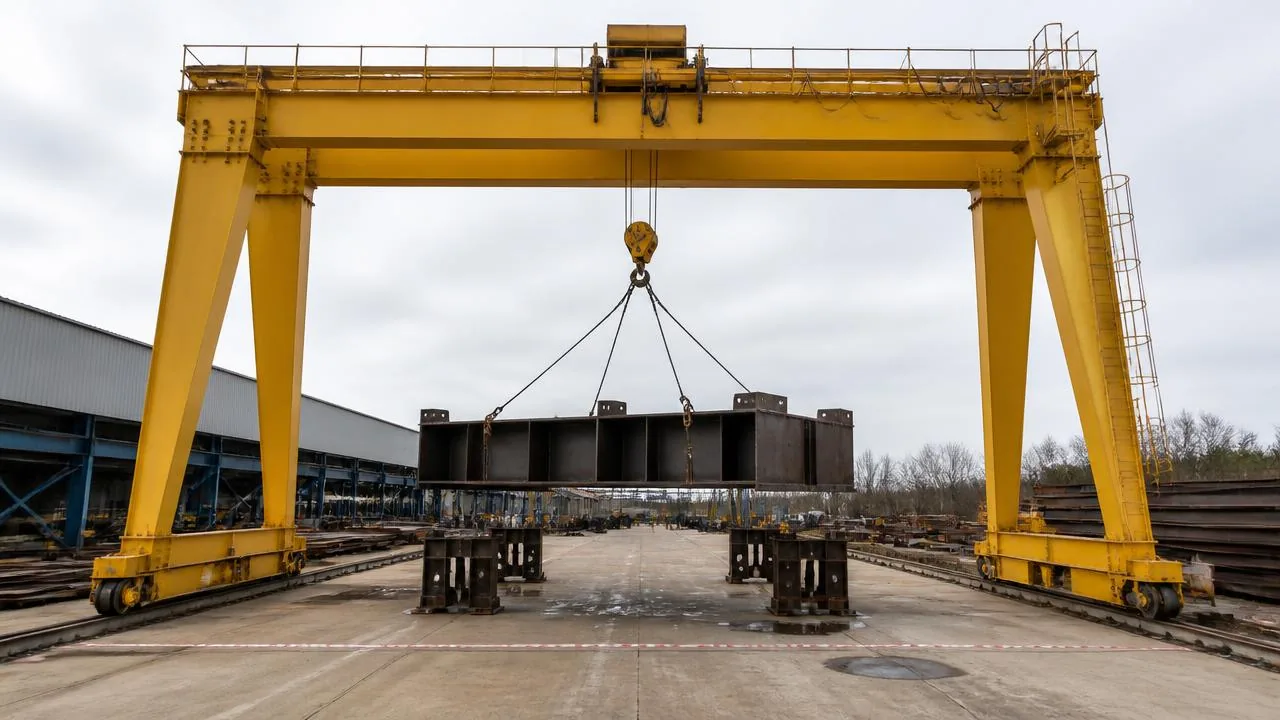
- Gantry crane — an overhead bridge carried on its own legs, running on floor rails or wheels. Covers a rectangle without needing building steel. Typical capacity 1 t to 1,000 t.
The single most important difference is where the load path goes. Jibs and overhead cranes transfer load into the building or a foundation. Gantries carry their own load path to the floor. That one distinction drives most of the cost difference between them.
Jib cranes
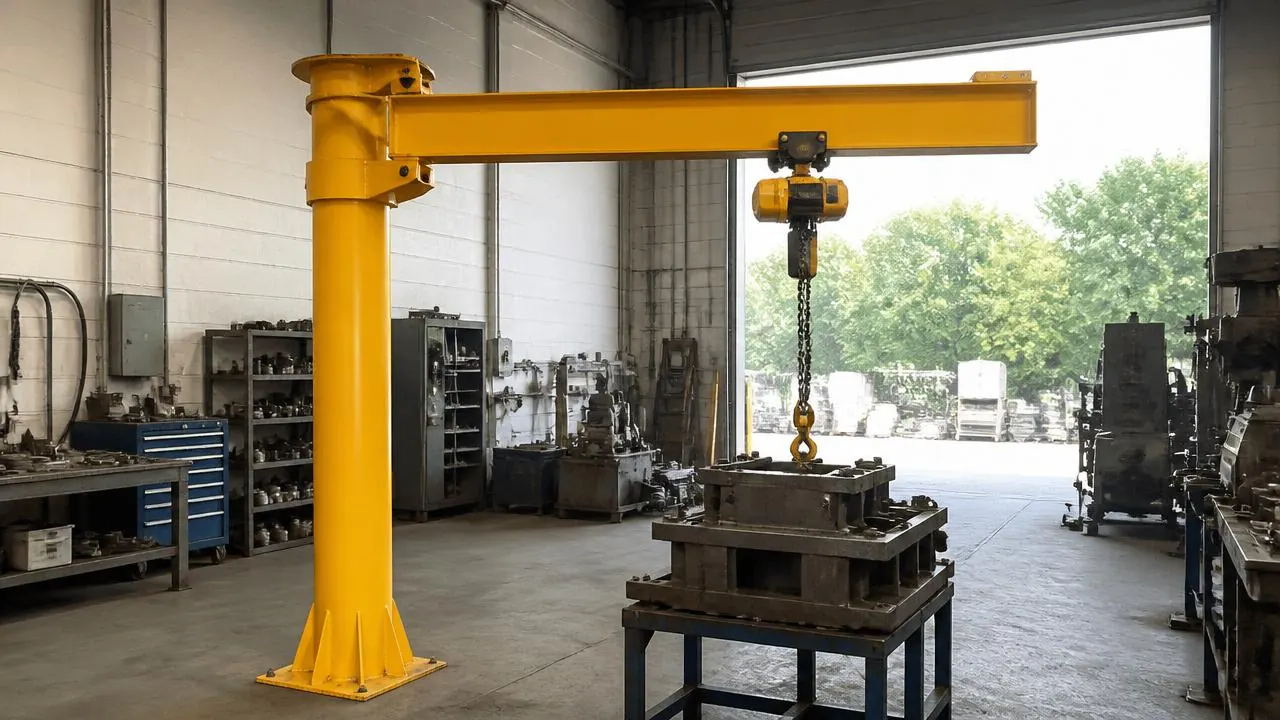
A jib crane is a horizontal boom that rotates around a vertical axis, with a hoist trolley travelling along the boom. Rotation is typically 180° (wall-mounted) or 360° (freestanding floor-mounted).
Main configurations:
- Freestanding floor-mounted — mast set in an engineered concrete foundation, full 360° rotation, the most capable jib type.
- Wall-mounted / wall-bracket — cantilevered off a building column or wall, 180°–200° rotation, no floor space consumed.
- Mast-type — mast supported top and bottom by existing structure, no foundation needed, 360° rotation.
- Articulating jib — two-piece boom with a second pivot, allowing the hook to reach around obstructions, into machine enclosures and around columns.
Where jib cranes win:
- Machine tending — loading and unloading a CNC lathe, press brake or injection moulding machine.
- Welding and fabrication cells where a fixed operator works a fixed radius.
- Loading dock, truck bed and container unloading points.
- Maintenance shops — pulling pumps, motors, gearboxes and valves off skids.
- Under-hook supplement to a main overhead crane, so the big crane isn't tied up on small picks.
Where they fail: anything that needs to travel down a bay. A jib only serves the circle it can sweep. Chaining three jibs together to move a part across a shop is a symptom that you needed a bridge crane. Freestanding jibs also demand a serious foundation — a 2-ton, 16-ft-span freestanding jib can require a 6–8 ft square, 4–6 ft deep reinforced footing. That foundation is frequently the largest single cost line, and it is the item most often missed in budget pricing.
Workstation cranes
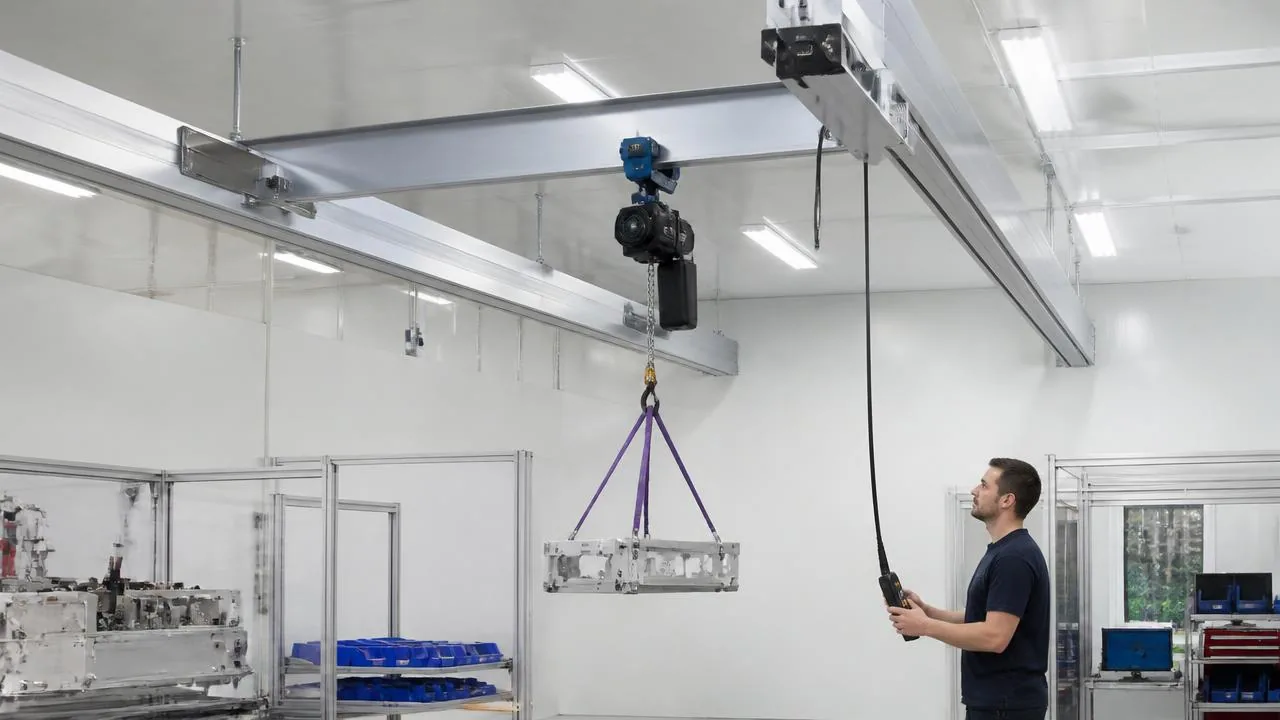
Workstation cranes (also called light-crane or enclosed-track systems) are a distinct family, not just "small overhead cranes." They use enclosed-track profiles — usually extruded aluminum or roll-formed steel — with captive trolleys running inside the track on precision wheels.
Defining characteristics:
- Very low rolling resistance. A properly installed workstation bridge can be pushed by hand with 2–5 lb of force per 1,000 lb of load.
- Ceiling-hung or freestanding on their own support columns — so they can be installed in a leased building with no roof steel capacity.
- Modular and relocatable. When the production cell moves, the crane moves with it.
- Capacities typically 150 lb to 2 tons, spans up to about 34 ft, with bridge and runway both in enclosed track.
Where workstation cranes win:
- Repetitive assembly work — the ergonomic case is the business case. Reducing manual lifting of 40–100 lb parts hundreds of times per shift is a direct injury-cost reduction.
- Pairing with vacuum lifters, air balancers and manipulators — see our post on below-the-hook attachments.
- Cells where precise, low-inertia positioning matters more than capacity: electronics, aerospace subassembly, medical device, food equipment.
- Facilities where the building steel cannot take a crane load and adding runway steel is unaffordable.
Where they fail: heavy, hot, dirty or high-duty service. Enclosed track is not designed for continuous heavy duty, abrasive dust, or the thermal environment of a foundry or mill. If duty is above roughly CMAA Class C equivalent, you are outside the family.
Overhead bridge cranes
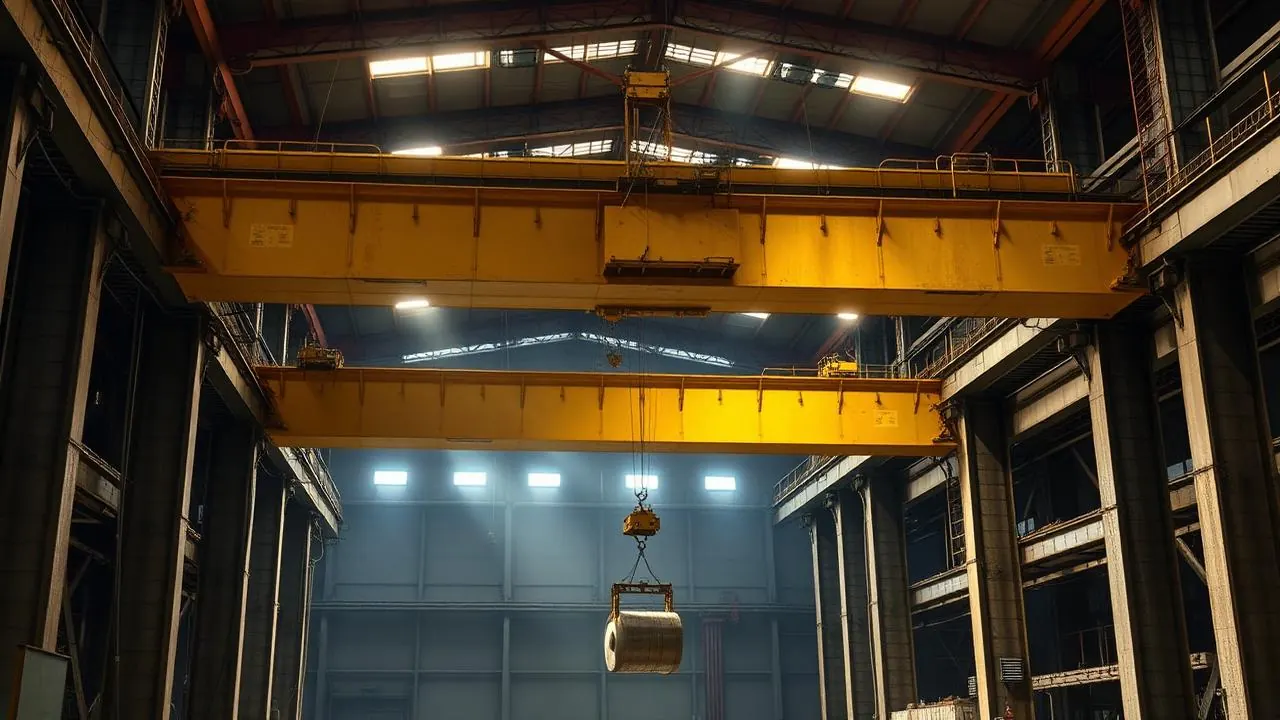
The overhead bridge crane is the backbone structure of industrial material handling: a bridge spanning between two runway rails, with a hoist trolley traversing the bridge. Three axes of motion give full rectangular coverage of the entire bay.
Main configurations:
- Top-running single girder — bridge end trucks ride on top of the runway rails, hoist is under-running on the bottom flange. The most common industrial crane, typically 1–20 t.
- Top-running double girder — trolley rides on rails on top of two girders. Maximum hook height, higher capacity, supports walkways, cabs and magnet/grab service. Standard above ~20 t.
- Under-running (under-hung) — end trucks ride the bottom flange of the runway beams, which can hang from roof steel. Excellent side approach, good for lower capacities where headroom is tight.
Duty class is the specification that matters most. CMAA service class A through F determines structure, mechanism sizing and expected life. Buying a Class C crane for Class E work is the single most expensive specification error in this industry — it will not fail immediately, it will fail in year four, out of warranty, and then keep failing.
Where overhead cranes win:
- Full-bay coverage where loads must move anywhere in the building footprint.
- Any heavy or high-duty service: steel mills, foundries, paper mills, power generation, mining process plants.
- Process-critical lifting where availability drives production — which is exactly why they need a formal preventive maintenance program and a documented inspection program under CSA B167 or ASME B30.2.
Where they fail commercially: small buildings and light duty. Runway beams, columns, footings, conductor bar, electrical feed and building modifications routinely equal or exceed the crane cost itself. If the real requirement is one machine-tending pick point, an overhead crane is a very expensive way to solve it.
Gantry cranes
A gantry crane is functionally an overhead bridge crane that carries its own supports. Instead of running on runway beams attached to the building, the bridge sits on legs that run on floor-mounted rails, on wheels, or on casters.
Main configurations:
- Full gantry — both legs on floor rails, span clear of obstruction, common in outdoor yards, precast plants, shipyards, container terminals and rail transfer.
- Semi-gantry — one leg on a floor rail, the other end running on an elevated runway on the building wall. Frees up floor space on one side and is a common retrofit into a bay with only one usable wall.
- Portable / adjustable A-frame gantry — rolling steel or aluminum gantry, typically 1–10 t, moved where the work is. Not a substitute for a fixed crane, but excellent for maintenance and low-frequency lifts.
- Rubber-tired and rail-mounted container gantries — the heavy end of the family, in ports and intermodal yards.
Where gantry cranes win:
- Outdoor lifting — laydown yards, precast concrete, pipe storage, module assembly, water and wastewater plants.
- Buildings whose structure cannot accept crane loads, and where new columns and runways are not economical.
- Rail and truck transfer bays where you need to lift over vehicles rather than through a building.
- Temporary or project-duration lifting where the structure must be relocated later.
Where they fail: floor space and traffic. Gantry legs occupy the floor and constrain forklift and personnel routes for the crane's entire travel length. Floor rails need flat, engineered, load-rated slab. Outdoor gantries also need wind-load design, storm anchors and rail clamps — items regularly omitted from budget quotes and then priced as change orders.
Cost and lifecycle comparison
Installed cost is what matters, not equipment cost. As a rough order of magnitude for North American industrial work:
- Workstation crane, 1 t, 20 ft span, freestanding — lowest installed cost of any bridge-type coverage; often no building modification at all.
- Wall-mounted jib, 1 t, 12 ft — low equipment cost, low install cost if the column can take it (it often cannot without reinforcement).
- Freestanding jib, 2 t, 16 ft — equipment cost is modest; the engineered foundation often costs as much as the crane.
- Top-running single girder overhead crane, 10 t, 60 ft span — crane is a minority of the project cost once runway, columns, footings, conductor bar, power and engineering are included.
- Full gantry, 10 t, 60 ft span, outdoor — higher equipment cost than the equivalent overhead crane, lower building cost, plus rail and slab work.
The lifecycle picture flips the ranking. Overhead cranes and gantries in real duty service consume inspection, spare parts, and eventually modernization budget for 30–40 years. Jibs and workstation cranes are comparatively low-maintenance, but they are also the ones most often left out of the plant's inspection program entirely — which is a compliance gap, since CSA B167 and ASME B30.11/B30.16/B30.17 cover them too.
How to choose — a practical decision sequence
- Map the actual moves. Where does the load start, where does it end, how many times per shift? Coverage geometry — circle, cell rectangle, full bay, outdoor yard — eliminates two of the four families immediately.
- Establish real capacity, including the attachment. The lifter, spreader bar, magnet or vacuum head is part of the load. Cranes get undersized here constantly.
- Establish duty cycle honestly. Lifts per hour, average load as a percentage of rated capacity, and hours per day. This sets CMAA class and drives 60% of the price difference between two "identical" cranes.
- Check the building before you check the catalogue. Roof steel capacity, column capacity, slab thickness, seismic and wind requirements. This is where jib versus gantry versus overhead is usually actually decided.
- Cost the whole installation. Foundations, runway, conductor bar, electrical feed, engineering, permits, load test and commissioning — see our load testing and commissioning guide.
- Plan the maintenance program on day one, not after the first failed inspection.
Where CAG fits
We are independent. We do not sell cranes, and we do not represent an OEM, so the recommendation you get is based on your duty data and your building — not on what somebody has in stock. We help owners, EPCMs and general contractors specify the right material handling structure, review vendor proposals for scope gaps, and build the inspection and maintenance program that keeps it available afterwards.
If you are deciding between a jib, a workstation crane, a gantry and an overhead crane right now, talk to an advisor before the RFQ goes out. That is the cheapest hour in the entire project.
FAQ
Frequently asked questions
- What is the main difference between a jib crane and an overhead crane?
- A jib crane has a boom that rotates around a fixed vertical mast, so it only covers a circle or part-circle around one point. An overhead bridge crane travels the full length and width of a bay on runway rails, giving rectangular coverage of the entire building footprint. Jibs suit single-point machine tending; overhead cranes suit moving loads anywhere in the bay.
- What is the difference between a gantry crane and an overhead crane?
- Both use a bridge and hoist trolley. An overhead crane transfers its load into the building through runway beams and columns; a gantry crane carries its own legs down to floor rails or wheels, so it needs no building steel. Gantries are the usual choice outdoors or where the structure cannot accept crane loads, at the cost of floor space along the travel path.
- When should I use a workstation crane instead of an overhead crane?
- Use a workstation crane when loads are light (typically under 2 tons), the work is repetitive within one cell, ergonomics matter, and duty is no heavier than roughly CMAA Class C. Enclosed-track workstation systems roll with very low force, can be freestanding in a leased building, and can be relocated when the cell moves. They are not suited to heavy, hot, dusty or high-duty service.
- What capacities do jib, workstation, gantry and overhead cranes cover?
- Jib cranes typically run from 125 lb to about 5 tons (occasionally 15 t). Workstation cranes typically run from 150 lb to 2 tons (up to about 4 t). Overhead bridge cranes cover roughly 1 t to 500 t and beyond. Gantry cranes span 1 t to 1,000 t, from portable A-frames to rail-mounted container gantries.
- Which crane type is the cheapest to install?
- Workstation cranes usually have the lowest installed cost because they often require no building modification. Wall-mounted jibs are inexpensive when the column can take the load without reinforcement. Freestanding jibs are often dominated by the cost of the engineered foundation, and overhead cranes are usually dominated by runway, columns, footings, conductor bar and electrical work rather than the crane itself.
- Do jib and workstation cranes need to be inspected like overhead cranes?
- Yes. CSA B167 in Canada and ASME B30.11, B30.16 and B30.17 in the United States cover monorails, hoists and under-running cranes as well as bridge cranes. Jib and workstation cranes are the equipment most often left out of a plant's inspection program, which is a common compliance gap found during audits.
- Why does CMAA duty class matter when choosing a crane type?
- CMAA service class A through F sets the structural and mechanical design basis for the crane. Specifying a Class C crane for Class E duty does not fail immediately — it typically fails in year three or four, out of warranty, and then repeats. Duty class drives a large share of the price difference between two cranes that look identical on a datasheet.
Related services
How CAG helps on this
Related industries
Industry pages worth reading next
More field notes
9 min · Maintenance
Who Should Define Your Overhead Crane Maintenance Scope — the Owner or the Service Contractor?
10 min · Service Contracts
Before You Renew Your Crane Service Contract: 10 Questions Owners Should Ask
7 min · EPC
Why Canada's EPCs and General Contractors Are the Backbone of Our Industrial Future