Crane Runway Rail Alignment: The Hidden Cause of Wheel, Rail and Structural Wear
Why overhead crane runway alignment drives wheel, rail and structural wear — CMAA 70 and ASME B30.2 tolerances, survey methods, warning signs and how to plan a runway survey.
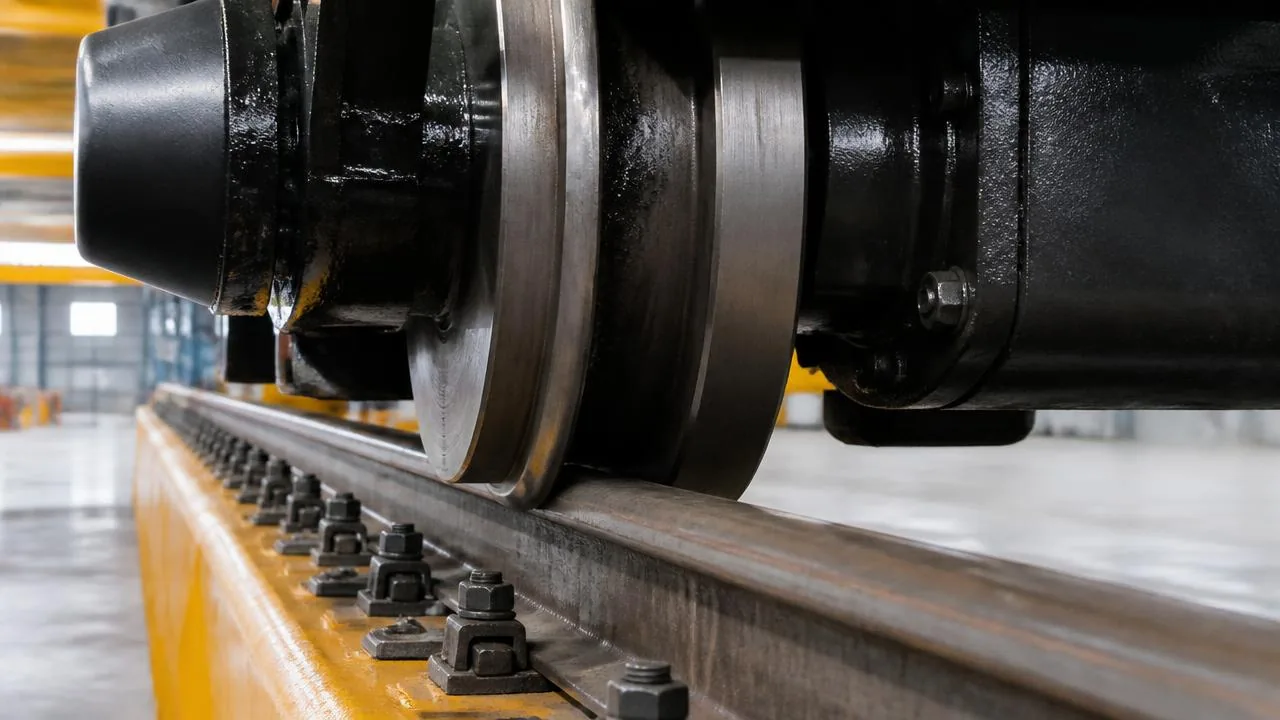
If an overhead crane chews through wheels every eighteen months, skews as it travels, squeals on long moves or trips the travel drives on acceleration, the crane is almost never the root cause. The runway is.
Runway rail alignment is the most under-inspected item in material handling. Owners inspect hoists, brakes, ropes and controls on a schedule because codes name them explicitly — but the two rails the crane runs on drift out of tolerance quietly over decades of building settlement, thermal movement, impact and column loading. By the time the symptoms are obvious, the plant has usually already paid for the damage several times over in wheels, end trucks, rail clips and downtime.
This guide covers what runway alignment actually means, the tolerances that apply, how a modern survey is performed, and how to fold it into a preventive maintenance program instead of reacting to failures.
What "runway alignment" actually measures
A crane runway is two parallel rails that must stay parallel, level, straight and at the same elevation, within tight limits, over the full length of the bay. A survey measures five separate things:
- Span — the centre-to-centre distance between the two rails, checked at intervals along the runway. This is the one that destroys wheels.
- Straightness — lateral deviation of each rail from a true straight line.
- Elevation — the height of each rail along its length (rail one relative to itself).
- Cross-elevation (level) — the height difference between rail one and rail two at the same station.
- Rail-to-girder position and rail condition — rail centred over the girder web, clip condition, joint gaps, head wear and rail cant.
A runway can be perfectly level and still be badly out of tolerance on span. A runway can hold span perfectly and still skew a crane badly because one rail curves. All five have to be measured together to mean anything.
The tolerances that apply
North American practice is governed primarily by CMAA Specification 70/74 for runway design and installation tolerances, with ASME B30.2 and CSA B167 requiring that the supporting structure be inspected and maintained. Typical published limits are:
- Span deviation: ± 3/16 in. (± 5 mm) for spans up to 50 ft, increasing modestly for longer spans — and, critically, a rate of change limit, usually 0.04 in. in 20 ft. A gradual 1/4 in. error over 300 ft is far less harmful than a 3/16 in. change over one bay.
- Straightness: typically ± 3/8 in. (10 mm) total over the full runway length, with the same local rate-of-change rule.
- Elevation: ± 3/8 in. (10 mm) over the length, and ± 1/4 in. in 20 ft locally.
- Cross-elevation between rails: typically ± 3/16 in. (5 mm) at any station.
- Rail joint gap: 1/16 in. at 70 °F, with no vertical or lateral step across the joint.
Note the pattern: the local rate of change matters more than the total error. A crane can tolerate a runway that slowly widens over 400 ft. It cannot tolerate a runway that jogs 1/4 in. across two bays — that is where wheels climb, flanges grind and end trucks crack.
The warning signs before anyone surveys anything
Runway problems announce themselves long before a survey is ordered. Field indicators to take seriously:
- Uneven wheel flange wear — one side of the crane consistently wearing flanges, or diagonal wear across the four wheels. Classic span or skew problem.
- Rail head side wear or lipping — the rail head mushrooming outward, or bright polished stripes on the rail gauge face.
- Crab or skew during travel — the crane leading with one end truck, then snapping back.
- Broken or loose rail clips, elongated bolt holes — the runway is transferring lateral load it was never designed to take.
- Cracked end trucks, bent equalizer pins, wheel bearing failures — late-stage symptoms.
- Travel motor overloads or VFD faults on acceleration — the drives fighting mechanical binding.
- Column base plate cracking, loose anchor bolts, girder web distortion — structural symptoms that outrun crane repair budgets fast.
One or two of these means schedule a survey. Three or more means schedule it now, before the next capital cycle prices the repair for you.
How a runway survey is performed today
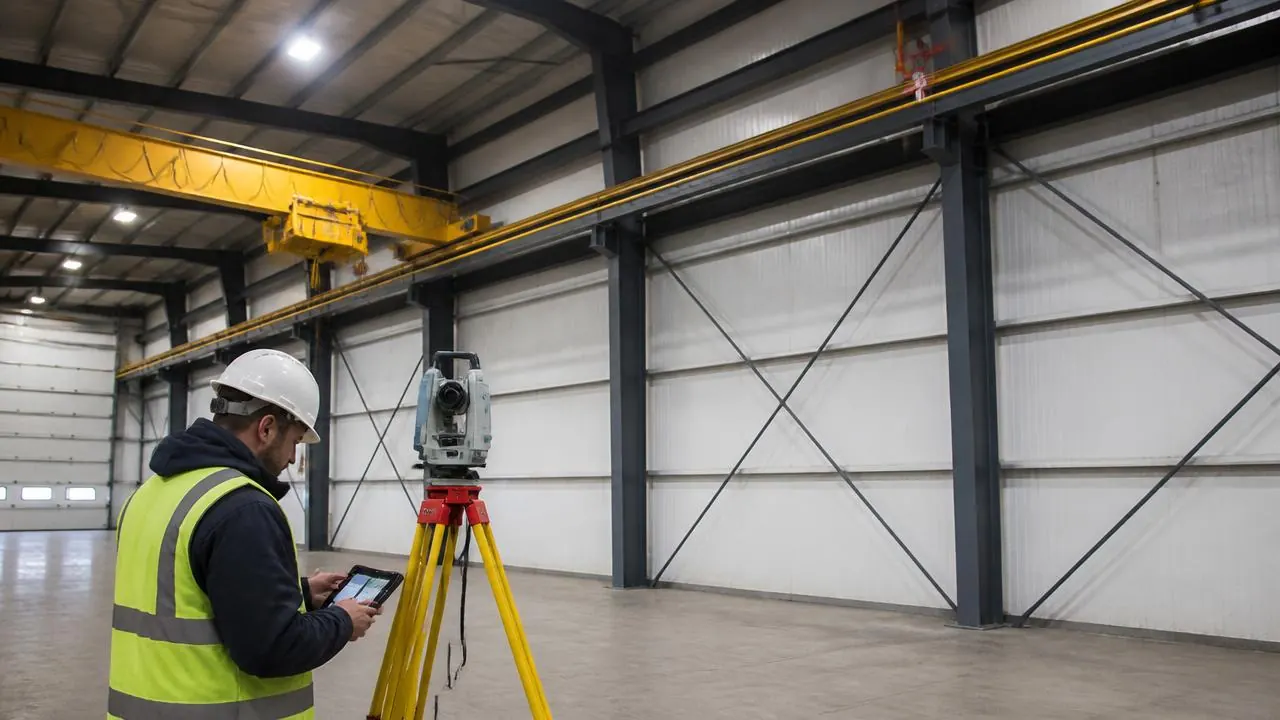
The old method was piano wire, a plumb bob and a transit — slow, requires crane downtime, and only samples a handful of points. Modern practice is a robotic total station or laser tracker survey, with a technician riding the crane or working from the floor with prisms mounted to the rail head.
A competent survey produces:
- A measured point set at regular stations (typically every 10–20 ft, and at every column) for both rails.
- Span, straightness, elevation and cross-elevation plotted against the CMAA tolerance envelope, so it is visually obvious where the runway leaves spec.
- Rail condition notes — head wear, joint condition, clip type and condition, rail-to-girder centring.
- A corrective action plan: which rails to shim, which to shift laterally, which clips to replace, which sections need rail replacement, and what the structure needs.
- A baseline for the next survey, so drift over time can be trended.
The survey does not require a shutdown in most plants. It typically needs controlled crane access for a shift or two, and it is often done during a planned maintenance window.
What corrections actually look like
Once the data exists, corrective work falls into a few predictable buckets, in ascending cost:
- Clip and fastener replacement — cheap, and often fixes a surprising amount of lateral drift.
- Lateral rail shifting — loosening clips and moving the rail within the girder flange to recover span. Bounded by how much room the flange gives you.
- Shimming for elevation and cross-elevation — steel shims under the rail or rail pad, engineered and welded/clamped properly.
- Rail replacement — when head wear, lipping or joint damage is beyond correction.
- Structural correction — girder, bracket or column work. This is engineering-led and is why a survey should be done before, not after, a modernization decision.
Where runway survey fits in a lifecycle plan
Our recommendation to owners:
- Baseline survey at installation. Make it a hold point in the contract, paid for by the installer, before final acceptance and load testing. Most runway problems we find were built in on day one.
- Re-survey every 3–5 years for Class C/D duty, every 2–3 years for Class E/F duty in steel mills, foundries and mining, and immediately after any structural modification, seismic event, foundation work or crane capacity increase.
- Survey before any modernization or crane replacement. Buying a new crane for an out-of-tolerance runway means the new crane inherits the same wear pattern — and the warranty claim will be denied. Pair the survey with a repair or replace assessment.
- Write survey results into the maintenance record so trend data exists next cycle.
The economics
A runway survey on a typical single-bay industrial crane runway is a small fraction of one set of crane wheels and end truck rebuilds — and wheels are the cheapest thing an out-of-tolerance runway destroys. The expensive outcomes are cracked girders, structural repairs performed under production pressure, and premature crane replacement.
The reason runway surveys get skipped is that no code names them on a fixed calendar the way inspections are named. That is exactly why they belong in an owner-driven asset management plan rather than a vendor's service checklist.
How CAG helps
We are independent — we do not sell rail, clips, wheels or installation labour. We specify the survey scope, review the surveyor's data against CMAA tolerances, translate the results into a prioritized corrective plan with budget ranges, and hold the contractor to the tolerance envelope on the correction work. If the survey changes the repair-versus-replace math, we say so before you commit capital.
If your cranes are eating wheels, skewing, or you have never had a baseline survey on a runway older than ten years, that is the place to start.
FAQ
Frequently asked questions
- How often should an overhead crane runway be surveyed?
- Baseline at installation, then every 3–5 years for CMAA Class C/D duty and every 2–3 years for Class E/F duty in steel mills, foundries and mining. Survey immediately after structural modifications, foundation work, a seismic event or a crane capacity increase.
- What is the allowable span tolerance for a crane runway?
- CMAA 70/74 typically allows ± 3/16 in. (5 mm) span deviation for spans up to 50 ft, with a local rate-of-change limit around 0.04 in. in 20 ft. The rate of change usually matters more than the total error, because abrupt local changes are what cause wheel climb and flange wear.
- What are the signs my crane runway is out of alignment?
- Uneven or rapid wheel flange wear, rail head side wear and lipping, the crane skewing or crabbing during travel, loose or broken rail clips with elongated bolt holes, travel drive overloads on acceleration, and cracked end trucks or distorted girder webs.
- Does a runway survey require a plant shutdown?
- Usually not. A modern total station or laser tracker survey needs controlled crane access for roughly one to two shifts and is normally scheduled inside a planned maintenance window rather than a full production shutdown.
- Should I survey the runway before buying a new overhead crane?
- Yes. Installing a new crane on an out-of-tolerance runway transfers the existing wear pattern straight to the new equipment and typically voids wheel and structural warranty claims. Survey first, correct the runway, then commission the crane.
Related services
How CAG helps on this
overhead crane preventive maintenance program
Overhead Crane Maintenance, Inspection & Service Program Review
Read moreoverhead crane asset management
Overhead Crane Asset Management
Read moreoverhead crane repair or replace assessment
Overhead Crane Repair-or-Replace Assessment
Read moreoverhead crane modernization consultant
Overhead Crane Modernization Consultant
Read more
Related industries
Industry pages worth reading next
More field notes
9 min · Maintenance
Who Should Define Your Overhead Crane Maintenance Scope — the Owner or the Service Contractor?
10 min · Service Contracts
Before You Renew Your Crane Service Contract: 10 Questions Owners Should Ask
12 min · Overhead Crane
Overhead Crane Modernization: Capacity Upgrades, Structural Reinforcement and What the Building Has to Do First