Below-the-Hook Lifting Attachments: Spreader Bars, Clamps, Vacuum Lifters and Magnets
A vendor-neutral overview of below-the-hook lifting devices — spreader bars, plate and coil clamps, vacuum lifters and lifting magnets — and how ASME B30.20 and BTH-1 apply to design, marking and inspection.
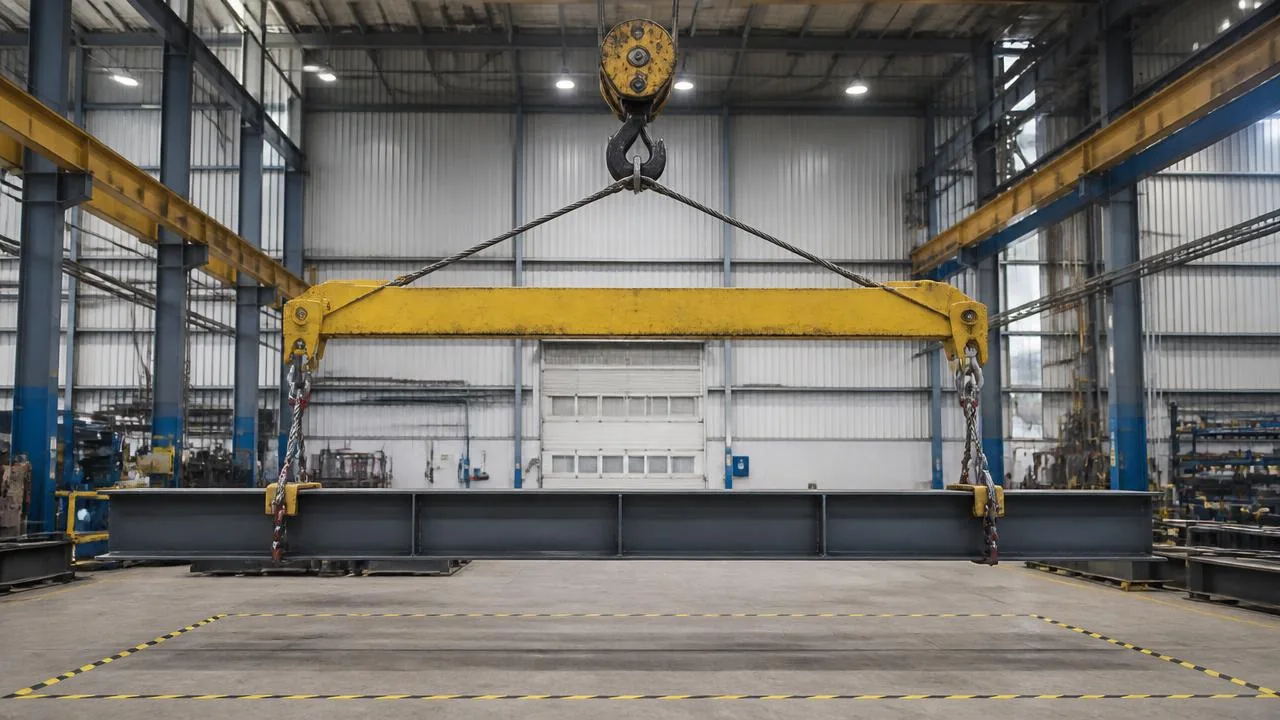
The overhead crane gets the attention, but on most jobs it is the below-the-hook (BTH) device that determines whether a lift is safe, fast and repeatable. A poorly specified spreader bar, an undersized clamp or the wrong magnet turns a good crane into a hazard.
This post is a vendor-neutral overview of the four families of below-the-hook devices we see most often on overhead crane and material handling projects — and the code framework every owner should be applying. It pairs with our ASME B30 Crane Consultant and Preventive Maintenance Program pages.
The code framework — ASME B30.20 and BTH-1
Below-the-hook devices in North America live under two ASME standards:
- ASME B30.20 — Below-the-Hook Lifting Devices. Covers marking, construction, installation, inspection, testing, maintenance and operation. Applies to structural and mechanical devices, vacuum lifters, close-proximity operated lifting magnets and remotely operated lifting magnets.
- ASME BTH-1 — Design of Below-the-Hook Lifting Devices. Companion design standard. Assigns each device a Design Category (A or B) and a Service Class (0 through 4) that together drive design factors and fatigue life.
Every device covered by B30.20 must be marked with rated load, weight, serial number and manufacturer, and must be proof tested at 125% of rated capacity before first use and after any repair to a load-bearing member. Inspection is required before each shift (visual) and on a documented periodic basis (thorough).
Owners who skip Design Category / Service Class selection at RFQ time are the ones who end up replacing devices every 2–3 years instead of every 15–20.
Spreader bars and lifting beams
Used to distribute a load between two or more hook points, control the spread of slings, keep sling angles above 60°, and prevent compression damage to long or fragile loads (vessels, structural steel, pre-cast panels, wind blades, transformers).
- Fixed spreaders — single design load, single geometry. Cheapest and most robust.
- Adjustable spreaders — pinned or telescoping to handle a range of loads.
- Modular spreader systems (e.g. Modulift, Britlift) — struts and end fittings assembled to job-specific geometry, engineered per lift.
Specification checklist: - Design Category B for lifts that are critical or engineered per lift; A for routine, well-defined lifts. - Service Class matched to number of lifts over the design life — a shipping-dock spreader is not the same as a maintenance-shop spreader. - Sling angle, bail height and hook clearance verified against the crane's headroom. - Certified drawings and a stamped design report on file.
Plate, coil and drum clamps
Mechanical clamps grab the load directly — plate clamps for structural steel and plate stock, coil grabs and C-hooks for steel coils, drum lifters for 205 L drums.
- Vertical plate clamps — for lifting plate in the vertical orientation. Rated load must exceed plate weight and the clamp must be sized for plate thickness range.
- Horizontal plate clamps (pairs) — for lifting plate flat, typically for turning or transferring.
- Coil grabs and C-hooks — steel-mill and service-centre workhorses; must be matched to coil ID/OD and weight.
- Drum lifters — parrot-beak and eagle-beak styles for steel drums; plastic drums need a different device.
Failure modes we see repeatedly: worn cam teeth on plate clamps, bent C-hook throats from overload, missing safety latches, and clamps used outside their marked plate thickness range. Every one of these is caught by a proper inspection program.
Vacuum lifters
Vacuum lifters pick smooth, non-porous loads — steel plate, glass, stone, composite panels, packaged goods — using suction pads and a vacuum pump or venturi.
- Powered vacuum systems — electric or pneumatic pump, vacuum reservoir, audible/visual low-vacuum alarm and (per B30.20) a means to hold the load if power is lost (reservoir + check valve, or gravity-latch backup).
- Venturi vacuum systems — driven by shop air, simpler but with continuous air consumption.
- Non-powered (self-priming) vacuum lifters — for lighter, defined loads.
Design and specification points: - Surface condition of the load — vacuum lifters need a defined roughness and no oil, scale or coating flake. - Number and size of pads sized to the load, orientation and any tilt during transport. - Redundancy — critical lifts require dual vacuum circuits or a mechanical backup. - Operator training on pre-lift vacuum checks, alarm response and emergency lowering.
Lifting magnets — permanent, electro and battery
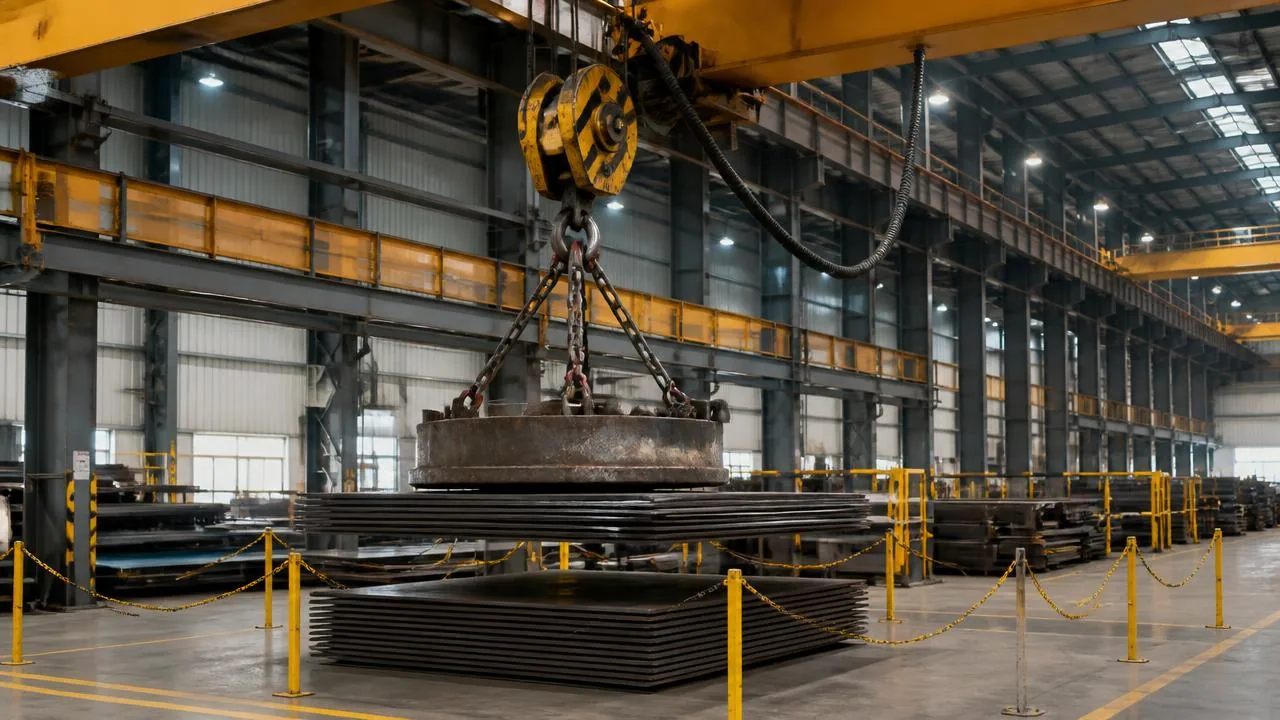
Magnets are the fastest way to move ferrous loads — plate, billet, slab, structural, scrap. B30.20 recognizes three families:
- Permanent magnets (manually switched). No power required. Rated load derated for plate thickness, air gap and surface condition. Common on fabrication shops and service centres.
- Electromagnets (DC powered). Higher lifting force per unit weight, but they drop the load if power is lost — hence B30.20's requirement for battery backup on any electromagnet used to lift material over personnel or where a dropped load is unacceptable.
- Battery-powered electropermanent magnets. Combine the switching convenience of an electromagnet with the fail-safe behaviour of a permanent magnet. Now the dominant choice for new steel-mill, foundry and fabrication installations.
Every magnet has a breakaway force (what it can hold under lab conditions) and a rated load (what it is marked and used for) — they are not the same number. Rated load must always account for plate thickness less than the reference thickness, air gap from scale or paint, surface curvature and temperature. Hot steel derates fast.
Where owners get burned
Common findings from our field audits:
- Devices in daily use with no rated-load tag, no serial number and no test record.
- Spreader bars fabricated in the plant's own weld shop, never engineered, never proof tested.
- Vacuum lifters used on painted or oxidized plate outside their qualification.
- Electromagnets used to lift over walkways with no battery backup.
- Coil grabs and C-hooks with visible throat deformation still in service.
- No documented periodic inspection under ASME B30.20.
Building a defensible BTH program
A working below-the-hook program has five pieces:
- Inventory — every device, tagged, with photo, rated load, serial number and location.
- Documentation — B30.20 marking, BTH-1 design report or certified engineering, proof test at 125% before first use and after repair.
- Inspection — pre-shift visual by the operator, documented periodic by a qualified inspector, frequency driven by service class and environment.
- Repair and retirement rules — written criteria for when a device is repaired, re-tested or scrapped.
- Training — operators trained on the specific device family they use (see our operator training post).
How CAG helps
Crane Advisory Group audits below-the-hook fleets, writes B30.20-compliant inspection programs, specifies new devices under BTH-1 Design Category and Service Class, and reviews proof-test documentation from suppliers such as Modulift, Bushman, Caldwell, Walker Magnetics, Eriez, Anver, Vacuworx and others. Talk to us about your next material handling or overhead crane project.
FAQ
Frequently asked questions
- Are below-the-hook devices covered by the crane's rated capacity?
- The weight of the device counts against the crane's rated capacity. The load the crane can lift is the rated capacity minus the weight of the spreader bar, magnet, vacuum lifter or other attachment.
- Do below-the-hook devices need their own inspection records?
- Yes. They are lifting devices in their own right, with their own rated capacity, marking, inspection frequency and documentation requirements.
- How do I choose between a magnet, vacuum lifter and mechanical clamp?
- Match the device to the material, surface condition, temperature, orientation of the lift and consequence of release. Power-off holding behaviour and backup systems matter most where a dropped load would be catastrophic.
Related services
How CAG helps on this
More field notes
10 min · Overhead Crane
Vacuum Lifters vs. Magnet Lifters: Choosing the Right Below-the-Hook Attachment for Your Overhead Crane
9 min · Maintenance
Who Should Define Your Overhead Crane Maintenance Scope — the Owner or the Service Contractor?
10 min · Service Contracts
Before You Renew Your Crane Service Contract: 10 Questions Owners Should Ask