Overhead Crane Load Testing and Commissioning Requirements: A Practical Guide
What CSA B167, ASME B30.2/B30.17 and OSHA require for overhead crane load testing and commissioning — proof loads, functional tests, documentation and sign-off.
How Crane Advisory Group Helps
Reading the standard is the easy part. Applying it to your cranes is the job.
Crane Advisory Group is an independent overhead crane and material handling consultancy led by Bryan Whitty, Founder & Principal Consultant, with 15+ years in the crane industry. We don't sell cranes, parts or service contracts — so what you get back is a recommendation, not a quote.
Compliance Gap Review
Where your maintenance, inspection and records program actually sits against the CSA B167 edition your province names — documented in writing.
Specs, Bids & Quotes Reviewed
Duty class, options, scope and exclusions checked before you sign — so you buy the crane or contract you need, not the one that was easiest to quote.
Independent Second Opinion
Repair, replace or modernize — reviewed by someone with no equipment, parts or service contract riding on the answer.
- In the overhead crane industry
- 15+ yrsIn the overhead crane industry
- Equipment, parts or service margin
- 0%Equipment, parts or service margin
- Standards referenced: CSA B167 · CMAA · ASME B30
- 3Standards referenced: CSA B167 · CMAA · ASME B30
- Scope and fee agreed before work starts
- FixedScope and fee agreed before work starts
Free download: CSA B167 Overhead Crane Compliance Checklist
A 5-page, vendor-neutral self-audit covering jurisdiction and edition, crane register, maintenance program, inspections and records, structure, electrical, training, modifications and vendor oversight. Enter your work email and the PDF opens immediately.
No newsletter spam. Every engagement follows the same documented review process.
See how an engagement worksA different cost structure than asking your crane supplier. Our work is advisory-only and scoped and quoted before it starts. There is no equipment margin, parts markup or service agreement attached to the advice — and a scoped review is a small line item next to the capital purchase, modernization or multi-year contract it is reviewing.
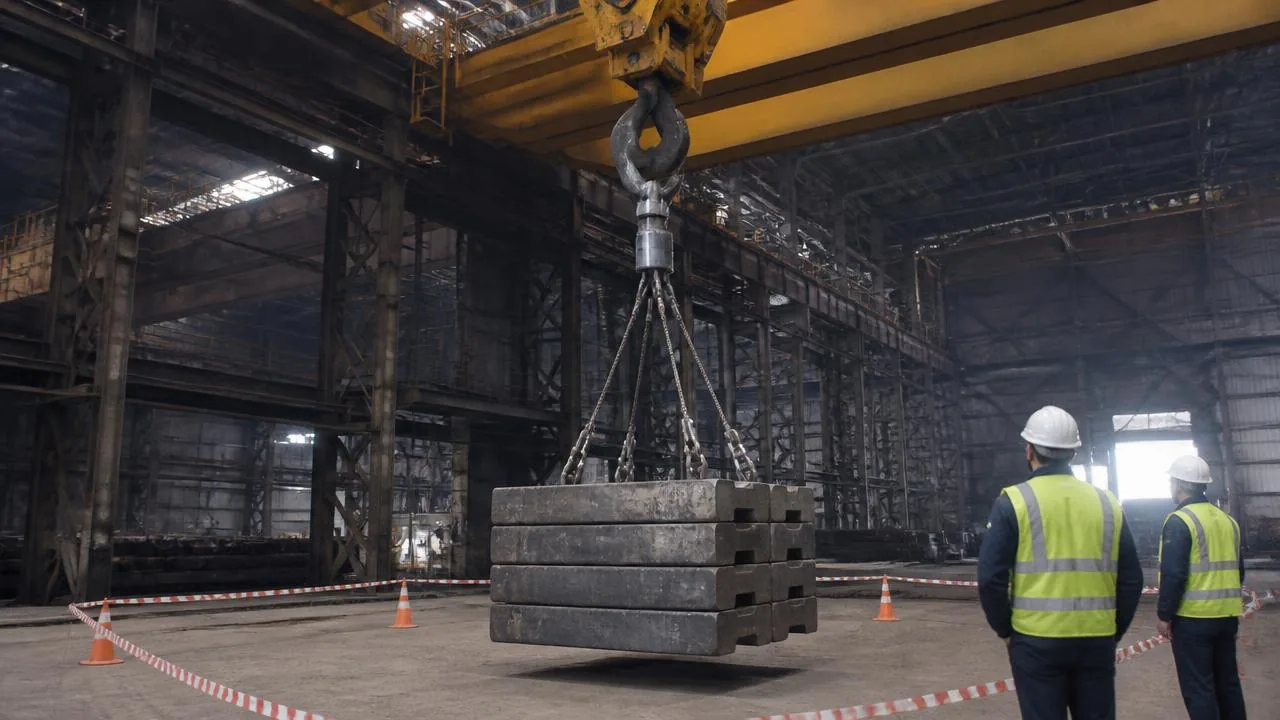
Load testing and commissioning is the last gate between a newly installed or modified overhead crane and safe production use. Get it right and the crane is documented, code-compliant and ready to run for decades. Get it wrong and you inherit a latent structural, electrical or brake defect that will surface at the worst possible moment.
This guide summarizes what CSA B167, ASME B30.2 / B30.17 and OSHA 1910.179 actually require, and how a proper commissioning package should be structured. It pairs with our Crane Inspection Program Consultant and Crane Service Program Consultant pages.
When a load test is required
A rated load test is triggered by any of the following:
- New installation — before first production use.
- Relocation or re-erection of an existing crane on a new runway.
- Structural alteration or repair to load-bearing members (bridge girders, end trucks, trolley frame, hoist load block, hooks).
- Major electrical or control modification that affects hoist braking, limits or overload protection (VFD retrofit, new brake, new upper limit).
- Replacement of load-bearing components — hoist unit, rope drum, load block, hooks.
- Periodic re-certification on a schedule set by the owner, insurer or jurisdiction.
Routine wire rope, brake or contactor replacement typically does not require a rated load test, but a functional test is always required.
Proof load values by code
- CSA B167-16 / B167-26 — 125% of rated capacity for new cranes and for cranes after structural alteration. Repairs to load-bearing parts are tested at 100–125% depending on the scope.
- ASME B30.2 (top-running) and B30.17 (under-running) — test load not less than 100% and not more than 125% of rated capacity unless the manufacturer specifies otherwise.
- ASME B30.16 (below-the-hook hoists) — 125% of rated capacity for new or altered hoists.
- OSHA 1910.179(k)(2) — before initial use, all new and altered cranes shall be tested at not less than 100% and not more than 125% of rated capacity.
The 125% number is the working ceiling for almost every overhead crane load test in North America. Testing above that value is not a "safety margin" — it can permanently deform structure and voids the manufacturer warranty.
Commissioning sequence
A proper commissioning package runs in this order. Skipping steps is the single most common cause of failed sign-offs.
- Pre-energization checks — runway alignment, rail sweep, bolt torque, grounding, cable management, limit-switch installation, nameplates, fall arrest and access.
- No-load functional tests — bridge, trolley and hoist in both directions, all speeds, all pendants/radios, e-stops, mainline disconnect, upper and lower geared limits, weightless block-operated limit, anti-collision, warning devices.
- Brake tests, no load — hoist holding brake, control braking (VFD), bridge and trolley brakes, coast distances against manufacturer spec.
- Rated load test — 100% — lift, hold, traverse the full runway, stop, hold suspended for a minimum time (typically 10 minutes) while inspecting girder deflection, brake slip and structural response.
- Proof load test — 125% — same sequence with a certified test load. Measure deflection at mid-span and compare against the manufacturer's allowable (typically L/888 to L/1000).
- Overload device test — verify the hoist overload cuts out before the mechanical rated-load limiter engages.
- Post-test inspection — full visual and NDT where required, torque check on critical fasteners, brake wear check.
- Documentation — signed test report, deflection measurements, calibration certificates for the test load, operator qualifications, drawings marked "as-built."
Choosing the test load
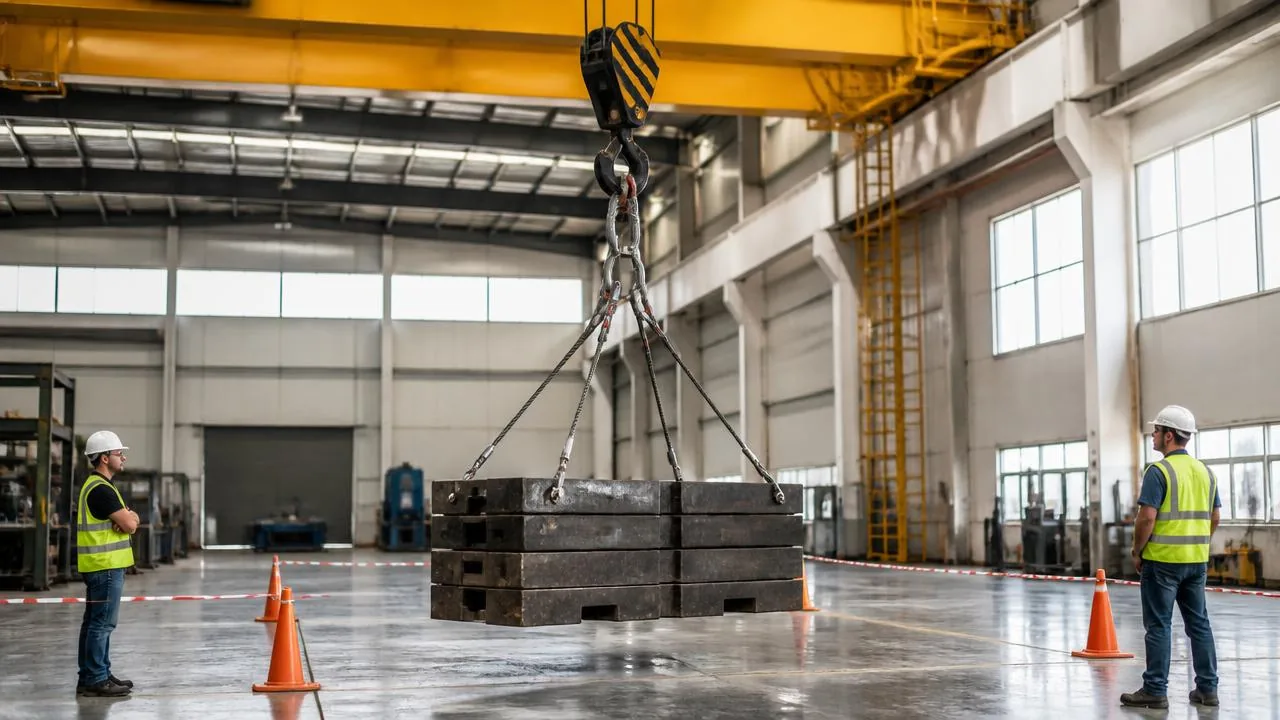
Solid weights, water weights and load cells all have a place. The right choice depends on capacity, headroom, floor loading, availability and risk.
- Solid weights — simple, cheap for small capacities, but hard to source, hard to rig safely and impossible to fine-tune above ~10–20 t.
- Water weights (suspended water bags) — the industry standard for cranes above ~5 t. Fill/drain in place, incremental loading, no swinging solid mass overhead. See our dedicated post on water weights and Unique Group.
- Hydraulic pull testers / load cells — used when there is no headroom for a suspended load, or on davits and monorails where a suspended bag will not clear.
- Existing plant loads — acceptable for functional verification, never acceptable as a certified proof load unless independently weighed and certified.
Every test load must be independently certified. "We think it's about 10 tons" is not a test.
Documentation that must exist at handover
A commissioning package that will survive an insurance audit, a Ministry of Labour visit or an OSHA inspection includes:
- Manufacturer data report, general arrangement drawings and electrical schematics
- Runway survey (rail alignment, span, elevation, camber)
- Erection and installation checklist signed by the installer
- Load test procedure and signed test report with the certified test load value
- Deflection readings vs. allowable
- Brake, limit and overload test results
- Operator training records (theoretical and practical — see our operator training post)
- Recommended preventive maintenance program and initial spare-parts list
Where owners get burned
The pattern we see on projects we're brought in to rescue:
- Test load not certified — the crane "passed" 125%, but no one can prove what the bag actually weighed.
- Deflection never measured — bridge is sagging under service load and no one has a baseline.
- Overload device never proved out — the setpoint drifted and no one caught it.
- No signed commissioning report — insurer refuses to cover a subsequent incident.
- Operators trained on a different crane — pendant layout, limit behaviour and brake feel are all different.
A vendor-neutral commissioning witness costs a fraction of one lost production day.
How CAG helps
Crane Advisory Group writes owner-side load test and commissioning procedures, witnesses the test, reviews the OEM's documentation package and signs off — or refuses to sign off — on behalf of the owner. Talk to us about your next new crane, modernization or repair project.
FAQ
Frequently asked questions
- What load test is required for a new overhead crane?
- New and modified cranes are typically proof tested above rated capacity in accordance with the applicable standard and manufacturer instructions, with results documented and retained. The exact percentage and procedure depend on the standard and jurisdiction that applies to the site.
- When does an existing crane need to be re-tested?
- Common triggers include structural repair, capacity change, hoist or rope replacement affecting the load path, major modernization and reinstallation after relocation.
- What should a commissioning package contain?
- Functional test records, load test results, limit and safety device verification, brake testing, alignment and clearance checks, as-built documentation, spare parts list and operator and maintainer training records.
Related services
How CAG helps on this
CSA B167 compliance consultant
CSA B167 Compliance Consultant
Read moreASME B30 crane consultant
ASME B30 Crane Consultant
Read moreoverhead crane inspection program consultant
Overhead Crane Inspection Program Consultant
Read moreoverhead crane service program consultant
Overhead Crane Service Program Consultant
Read moreoverhead crane preventive maintenance program
Overhead Crane Maintenance, Inspection & Service Program Review
Read more
Related industries
Industry pages worth reading next
More field notes