Overhead Crane Power Distribution Explained: Conductor Bars, Busbar, Festoon, and Energy Chain
How overhead cranes get power: enclosed conductor bars, open busbar, festoon systems, energy chains, cable reels, and battery/wireless options — with selection criteria, failure modes, and a specification checklist.
Every overhead crane needs two things the building has to supply: a structure to run on, and electrical power delivered to a machine that never stops moving. The second one is where a surprising number of reliability problems start.
Power distribution — the industry usually calls it crane electrification or conductor systems — is the set of components that carry power and control signals from a fixed source to a moving bridge, and from the moving bridge to a moving trolley and hoist. Get it right and it is invisible for twenty years. Get it wrong and you get nuisance trips, arcing, dropouts on the radio, carbon dust on the girder, and hoists that stall on long runs.
This guide covers the main methods — enclosed conductor bar, open busbar, festoon, energy chain, cable reels, and the newer battery and capacitor approaches — what each is actually for, where they fail, and how to specify the right one in an RFQ.
The two power paths on every crane
Before comparing products, be clear about which of the two runs you are talking about. They are almost always different systems.
| Run | From → To | Length | Typical method |
|---|---|---|---|
| Runway (bridge) power | Fixed disconnect on the building → moving bridge | The full bay length, often 100–1,500 ft | Enclosed conductor bar, open busbar, or runway festoon |
| Bridge (cross-travel) power | Bridge → moving trolley/hoist | The crane span, typically 20–120 ft | Festoon, energy chain, or a small conductor bar |
A common specification error is to name one system and assume it covers both. The RFQ should state the method, conductor count, amperage, and voltage for each run separately.
1. Enclosed conductor bar (the modern default)
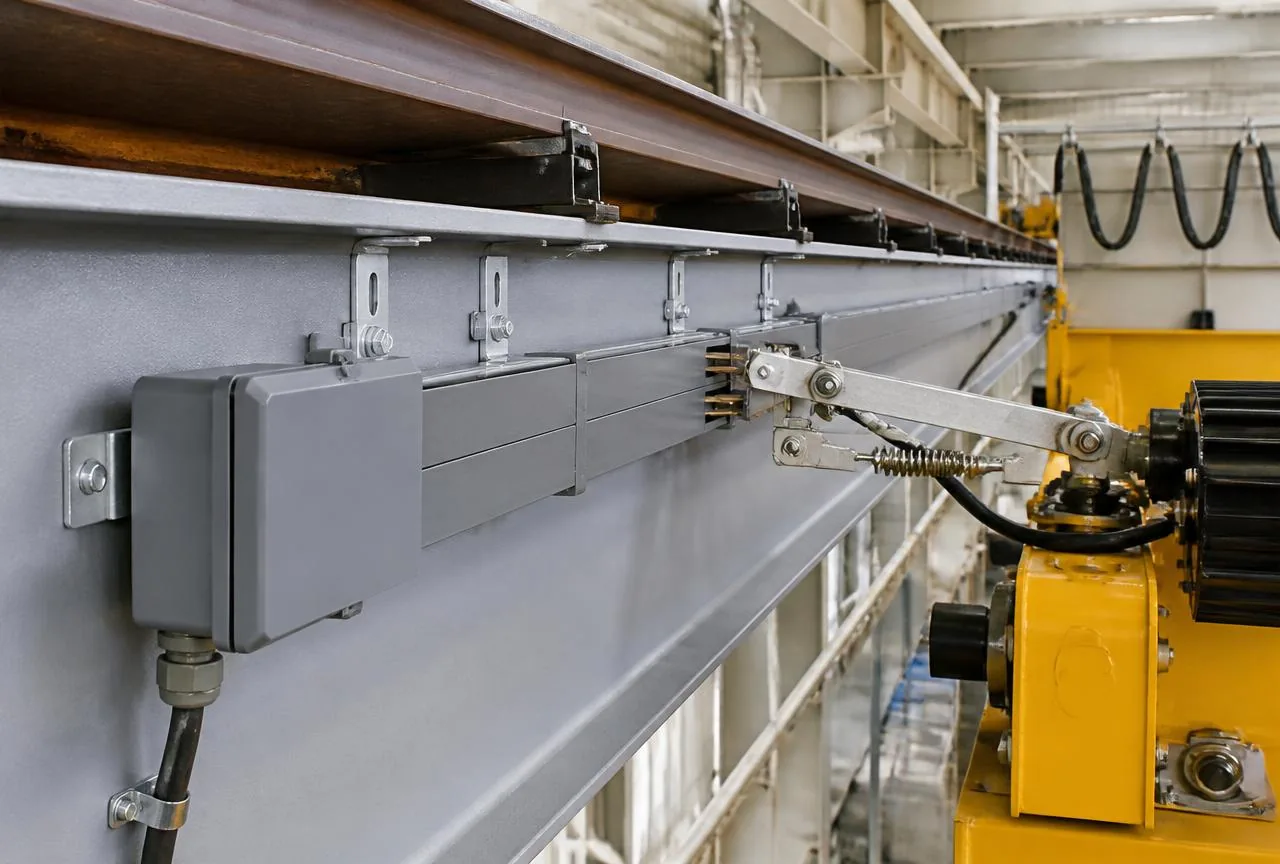
An enclosed conductor bar is a rigid copper or copper-clad conductor housed inside an insulating PVC or fiberglass extrusion. A collector arm mounted on the crane carries carbon or copper-graphite shoes that ride inside the housing and pick up current continuously along the run.
Purpose: continuous, high-speed, high-amperage power over long distances with minimal moving mass and no trailing cable.
Where it fits: almost all new runway installations, and cross-travel on wide-span or high-duty cranes.
Strengths - Enclosed housing keeps fingers out and dust, water spray, and debris off the conductor. - No practical length limit — you add sections and expansion joints. - Low maintenance: shoe replacement on a wear schedule, and periodic alignment checks. - Handles high travel speeds better than any cable-based method. - Available in single-pole and multi-pole configurations, in figure-8, box, or compact profiles.
Weaknesses and failure modes - Misalignment is the number one killer. If the bar is not parallel to the rail within the manufacturer's tolerance, the collector shoe side-loads, wears unevenly, and eventually loses contact. A crooked runway produces a crooked conductor bar — see runway rail alignment. - Expansion joints must be installed and set at the right ambient temperature. Missing or mis-set joints buckle the bar in summer and open gaps in winter. - Voltage drop on long runs. A 1,200 ft runway with a big hoist at the far end can brown out if the bar amperage and feed points were sized for the nameplate current, not the starting current. - Carbon dust accumulation in clean or food-grade environments. - Splice heating where joints were not torqued or where dissimilar metals were used.
What to specify: amperage rating, number of poles (including a dedicated ground and any spare poles for future controls), housing material, IP/NEMA rating, feed point locations, expansion joint spacing, collector type and quantity, and whether an isolation section is needed for maintenance.
2. Open busbar (legacy, still present)
Open busbar — bare copper, aluminum, or steel angle/rail conductors mounted on insulators along the runway — is the oldest method still found in service. Collector shoes ride on the exposed face.
Purpose: simple, very high current capacity, historically inexpensive.
Reality today: open conductors are an exposed shock hazard. Many jurisdictions require guarding, minimum clearances, and warning signage, and most owners cannot justify keeping them once a modernization is on the table. In hot environments — steel mills, foundries — heavy bare bar is still occasionally specified because it tolerates radiant heat better than plastic housings, but even there enclosed high-temperature systems now exist.
When we recommend replacement: any open busbar in an area with maintenance access, personnel traffic, or a CSA/OSHA finding. Replacing open bar with enclosed conductor bar is one of the highest-value, lowest-disruption modernization items available.
3. Festoon systems
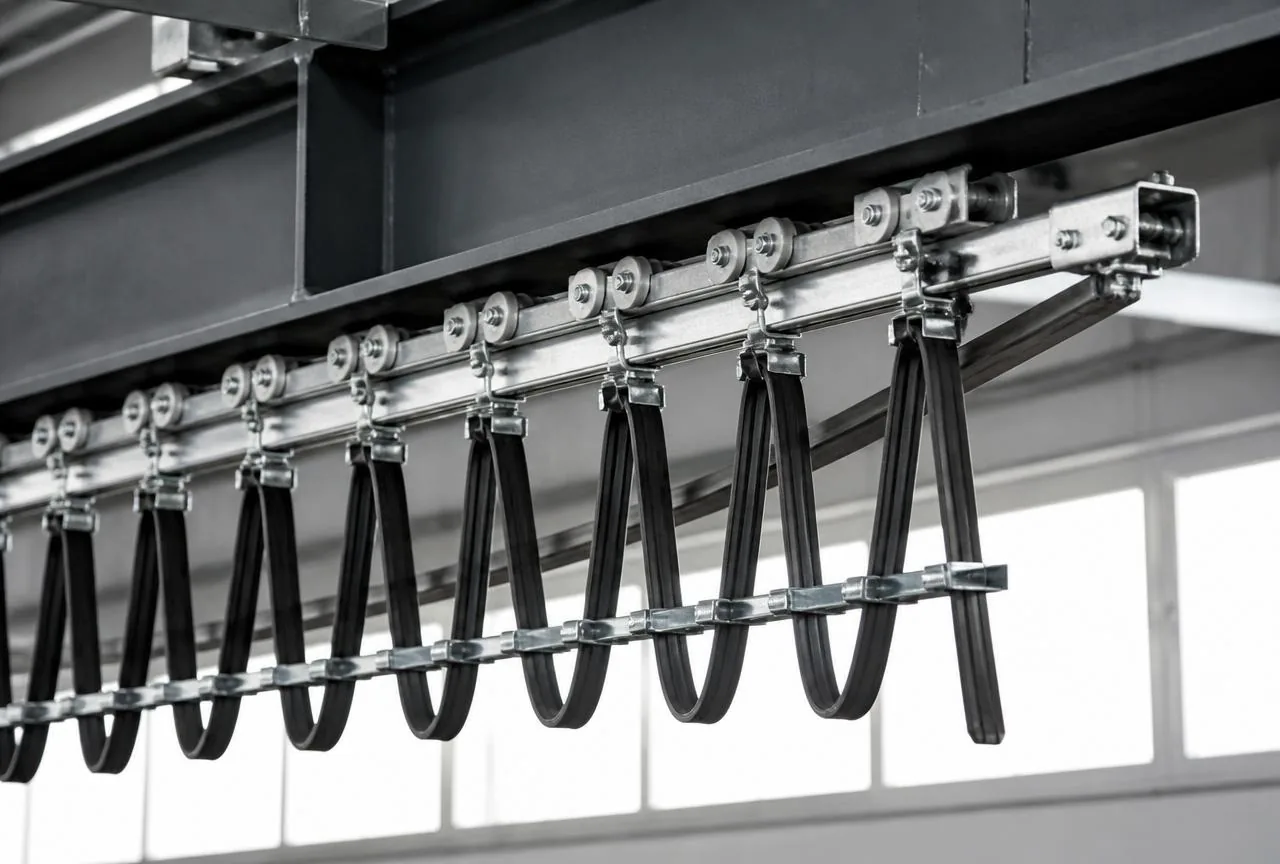
A festoon system carries flat or round cable in loops suspended from trolleys that roll along a track. As the crane or trolley moves, the loops gather at one end and pay out at the other.
There are two mounting styles:
- C-track festoon — trolleys run inside an enclosed C-shaped steel or aluminum track. The standard for cross-travel on most single- and double-girder cranes, and for shorter runway runs.
- Wire rope (cable) festoon — trolleys hang from a tensioned steel rope. Cheaper, used outdoors and on light-duty or long, slow runs, but it sags and is harder to keep tidy.
Purpose: carry power and control and data in the same run — three-phase power, control wiring, encoder or fieldbus cable, pendant cable, and even pneumatic or hydraulic hose in one system.
Strengths - Multi-conductor and multi-service in one carrier. If your trolley needs Ethernet, load-cell signal, and 480 V in one run, festoon does it in one pass. - Fully insulated — no exposed live parts. - Simple to repair with common parts. - Works well outdoors with the right cable jacket.
Weaknesses and failure modes - Speed and acceleration limits. Festoon does not like high travel speeds or hard stops; trolleys pile up and cables whip. - Cable fatigue at the strain relief and at the tow arm — the most common failure point. Flat cable with the correct number of bending cycles rating matters. - Track debris and corrosion cause trolleys to bind, which then drags the cable. - Occupies headroom and hook approach, especially on short spans. - Wind loading on outdoor cable festoon.
What to specify: track type, cable type and conductor schedule (power, ground, control, data — listed separately), trolley count and spacing, tow arm, end clamps, loop depth, travel speed and acceleration, and the environment (heat, chemicals, UV, washdown).
4. Energy chain (cable carrier / drag chain)
An energy chain is a hinged plastic or steel carrier that contains and guides cables through a controlled bend radius as it rolls over on itself in a trough or on a guide.
Purpose: precise, high-cycle, high-speed cable management where festoon loops would be too slow, too messy, or where the cable must be protected from contact.
Strengths - Handles far higher speeds and accelerations than festoon. - Very long service life measured in millions of cycles when the bend radius and fill are correct. - Cables are protected and separated internally — power and data can be segregated inside the same chain to control interference. - Compact, predictable envelope. No swinging loops. - Well suited to automated and semi-automated cranes, process cranes, and clean environments where cable dust and swing are unacceptable.
Weaknesses and failure modes - Cost is higher than festoon on the same run. - Chain-rated cable is mandatory. Standard cable installed in a chain will corkscrew and fail early. This is the single most common energy-chain failure we see. - Fill ratio and separator layout must be engineered; over-filling causes internal abrasion. - Requires a guide trough on long horizontal runs, which needs support steel and stays clean or it jams. - Plastic chain has temperature limits — hot mill environments need steel or hybrid chain.
5. Cable reels
A motorized or spring-driven reel winds and unwinds a single cable as the crane travels.
Purpose: long, straight travel where a fixed track is impractical — outdoor gantries, container handling, some mining and bulk yard applications, and mobile equipment feeding.
Strengths: no track structure required over the full run; tolerant of long distances and outdoor exposure.
Weaknesses: slip rings wear and need maintenance; reeling cable is a specialty item; the reel is a single point of failure; cable twist and tension control require attention. Rarely the right answer for an indoor bay crane.
6. Battery, capacitor, and contactless options
Newer approaches show up in specifications more often each year:
- Battery-powered cranes and hoists for light-duty, low-cycle, or temporary applications where running a conductor system is disproportionate.
- Capacitor / short-charge systems for shuttle-style movements with frequent stops at a charge point.
- Inductive (contactless) power transfer, used in clean rooms and some automated storage applications, where no sliding contact is acceptable.
These are legitimate for the right application but should be evaluated against duty cycle, availability requirements, and total lifecycle cost — not novelty. On a Class D or E production crane running three shifts, conductor bar remains the reliable answer.
Choosing between them
| Criterion | Enclosed conductor bar | Festoon | Energy chain | Cable reel |
|---|---|---|---|---|
| Long runway runs | Best | Fair | Fair | Good |
| Cross-travel on bridge | Good | Best (common) | Good | Poor |
| High travel speed | Best | Poor | Best | Fair |
| Power + data in one run | Limited | Best | Best | Limited |
| Headroom / hook approach | Best | Fair | Good | Fair |
| Harsh heat / molten metal | Special versions | Poor | Steel chain only | Poor |
| Washdown / food grade | Good (sealed types) | Good | Good | Fair |
| Maintenance burden | Low | Medium | Low–Medium | High |
| Capital cost | Medium | Low | High | High |
A practical default for a new indoor production crane: enclosed conductor bar on the runway, C-track festoon or energy chain on the bridge, with the choice between the last two driven by cross-travel speed and how much data the trolley needs to carry.
Where electrification quietly costs owners money
In our bid reviews and inspections, these are the recurring findings:
- Amperage sized on nameplate current, not starting current. Hoist motors draw multiples of full-load current on acceleration. Undersized bar causes voltage sag that trips drives at the far end of the runway.
- No spare poles. Adding a load monitor, RFID access control, anti-collision, or a warning light later means pulling a whole new system because nobody specified two spare conductors on day one. Spare poles cost almost nothing at build time.
- Mixed vendor components on one run. Collector shoes from one system in another manufacturer's housing wear out fast and void warranties.
- Expansion joints omitted on runs over the manufacturer's threshold, or installed without recording the ambient temperature at setting.
- No isolation section at the maintenance platform, so any work on one crane de-energizes the whole bay — a real production cost in a multi-crane aisle.
- Grounding treated as an afterthought. A dedicated ground pole and continuous bonding path are code requirements, not options, and they matter more once VFDs are in the picture.
- Standard cable in an energy chain, or non-festoon-rated flat cable in a festoon. Both fail years early.
- Electrification excluded from the PM program. Collector shoe wear, alignment, splice torque, and track cleanliness belong in the preventive maintenance scope with defined intervals.
Compliance and standards context
Crane electrification is governed by a mix of crane and electrical requirements:
- CSA B167 (Canada) and ASME B30.2 / B30.17 (US) — general crane requirements including guarding of live parts, disconnects, and inspection.
- CMAA 70 / 74 — specification content for the crane, including electrification requirements.
- Canadian Electrical Code / NFPA 70 (NEC) — Article 610 covers cranes and hoists specifically: conductor sizing, disconnecting means, grounding, and contact conductor clearances.
- Hazardous locations — in a classified area, the conductor system must match the area classification. See hazardous location cranes.
Article 610 is the one owners most often have not read. It sets minimum conductor ampacity based on duty and on the number of cranes on a runway, and it drives the disconnect and grounding arrangement.
Specification checklist
Copy this into your next RFQ. Answer each line for both the runway and the bridge run.
- Method: enclosed conductor bar / open bar replacement / C-track festoon / cable festoon / energy chain / cable reel.
- System voltage, phase, and frequency.
- Continuous amperage and peak/starting amperage, with the calculation basis stated.
- Number of cranes sharing the runway, now and planned.
- Number of poles including ground, plus a minimum of two spare poles.
- Total run length, and feed point locations.
- Travel speed and acceleration/deceleration rates.
- Environment: temperature range, humidity, washdown, dust, chemical exposure, UV, radiant heat.
- Enclosure rating (NEMA / IP) required.
- Expansion joint requirements and installation ambient temperature.
- Isolation/maintenance section requirements and location.
- Collector type, quantity, and spare shoe supply with the crane.
- Data/control services carried: pendant, radio antenna, encoder, fieldbus, load cell, camera.
- Hazardous location classification, if any.
- Documentation: as-built drawings, conductor schedule, voltage-drop calculation, and PM instructions.
How CAG helps
We do not sell conductor bar, festoon, or energy chain. When we review a specification or a bid, we are checking whether the electrification method matches your duty cycle, run length, environment, and future plans — and whether the amperage, spare poles, expansion joints, and grounding were actually engineered rather than copied from the last project.
If you are procuring a new crane, modernizing an old runway, or chasing intermittent faults that nobody can pin down, see specification review, bid review, and preventive maintenance.
FAQ
Frequently asked questions
- What is the difference between busbar and conductor bar?
- They describe the same function — a rigid conductor that a collector shoe rides along — but in common usage 'open busbar' means bare, exposed conductors on insulators, while 'enclosed conductor bar' means copper conductors housed inside an insulating PVC or fiberglass extrusion. Enclosed conductor bar is the modern standard because the live parts are guarded.
- When should I use festoon instead of conductor bar?
- Use festoon when you need to carry power, control, and data in the same run — for example a trolley that needs three-phase power plus encoder, load-cell, and fieldbus wiring. Festoon is also the common choice for cross-travel on the bridge. Conductor bar is better for long runway runs and high travel speeds.
- What is an energy chain used for on a crane?
- An energy chain, or cable carrier, guides cables through a controlled bend radius as the trolley or bridge moves. It is used where high travel speed, high cycle counts, or cable protection matter more than capital cost — automated cranes, process cranes, and clean environments. It requires chain-rated cable; standard cable fails early inside a chain.
- How long can a conductor bar runway be?
- There is no practical length limit — sections are added with splice joints and expansion joints. The real limit is voltage drop. On long runs the system must be sized for starting current, not just nameplate current, and additional feed points are added along the run to keep voltage within tolerance at the far end.
- Do I need spare poles in my crane electrification system?
- Yes. Specify at least two spare conductors. Adding a load monitor, anti-collision system, RFID operator access control, or warning device later is inexpensive if spare poles exist and very expensive if they do not, because the whole run may have to be replaced.
- What maintenance does crane electrification need?
- Collector shoe wear measurement and replacement, alignment checks against the rail, splice and feed-point torque verification, insulation resistance testing, track and housing cleaning, and inspection of festoon cable strain reliefs and trolley wheels. These items belong in the documented preventive maintenance program with defined intervals.
Related services
How CAG helps on this
overhead crane specification review
Overhead Crane Specification Review
Read moreoverhead crane bid review
Overhead Crane Bid Review
Read moreoverhead crane preventive maintenance program
Overhead Crane Maintenance, Inspection & Service Program Review
Read moreoverhead crane modernization consultant
Overhead Crane Modernization Consultant
Read moreoverhead crane inspection program consultant
Overhead Crane Inspection Program Consultant
Read more
Related industries
Industry pages worth reading next
More field notes
9 min · Maintenance
Who Should Define Your Overhead Crane Maintenance Scope — the Owner or the Service Contractor?
10 min · Service Contracts
Before You Renew Your Crane Service Contract: 10 Questions Owners Should Ask
14 min · Maintenance
Motors, Gearboxes and Gearing: The Obsolete Parts That Keep Cranes Down for Weeks