RFID Access Cards for Overhead Cranes: Qualified Operators Only, Full Accountability
How RFID access control on overhead cranes restricts operation to qualified operators, creates an audit trail, and strengthens accountability under CSA B167 and ASME B30.

How Crane Advisory Group Helps
Reading the standard is the easy part. Applying it to your cranes is the job.
Crane Advisory Group is an independent overhead crane and material handling consultancy led by Bryan Whitty, Founder & Principal Consultant, with 15+ years in the crane industry. We don't sell cranes, parts or service contracts — so what you get back is a recommendation, not a quote.
Compliance Gap Review
Where your maintenance, inspection and records program actually sits against the CSA B167 edition your province names — documented in writing.
Specs, Bids & Quotes Reviewed
Duty class, options, scope and exclusions checked before you sign — so you buy the crane or contract you need, not the one that was easiest to quote.
Independent Second Opinion
Repair, replace or modernize — reviewed by someone with no equipment, parts or service contract riding on the answer.
- In the overhead crane industry
- 15+ yrsIn the overhead crane industry
- Equipment, parts or service margin
- 0%Equipment, parts or service margin
- Standards referenced: CSA B167 · CMAA · ASME B30
- 3Standards referenced: CSA B167 · CMAA · ASME B30
- Scope and fee agreed before work starts
- FixedScope and fee agreed before work starts
Free download: CSA B167 Overhead Crane Compliance Checklist
A 5-page, vendor-neutral self-audit covering jurisdiction and edition, crane register, maintenance program, inspections and records, structure, electrical, training, modifications and vendor oversight. Enter your work email and the PDF opens immediately.
No newsletter spam. Every engagement follows the same documented review process.
See how an engagement worksA different cost structure than asking your crane supplier. Our work is advisory-only and scoped and quoted before it starts. There is no equipment margin, parts markup or service agreement attached to the advice — and a scoped review is a small line item next to the capital purchase, modernization or multi-year contract it is reviewing.
Most overhead crane incidents are not equipment failures — they are authorization failures. A press operator borrows a pendant to move a load. A maintenance tech runs a crane without current certification. A supervisor overrides the lockout because "it will only take a minute." RFID access cards close those gaps by making the crane itself enforce who is allowed to run it.
This post explains how RFID access control works on overhead cranes and material handling systems, what it takes to install, and why it is one of the fastest-returning safety upgrades a plant can make.
What RFID access control does on an overhead crane
An RFID-enabled crane will not start until a valid card is presented. The reader checks the card against a database of authorized operators, then releases the control circuit. If the card is expired, suspended, or not trained on that specific crane class, the crane stays dead.
The same system records every login: operator ID, crane ID, date, time, and duration. That log becomes the backbone of accountability after a near miss, an incident investigation, or an insurance audit.
Why it matters for accountability
Without access control, crane operation logs are mostly paper-based or nonexistent. After an incident, the question "who was running it?" can take days to answer — if it can be answered at all.
With RFID access cards:
- Only qualified operators can energize the crane. Training records, medical fitness, and recertification dates are checked automatically.
- Every session is attributable. The operator knows the crane knows who is logged in.
- Supervisor overrides are logged too. Temporary authorizations can be granted, but not anonymously.
- Audit trails satisfy regulators and insurers. CSA B167 and ASME B30 both expect documented operator qualification programs.
How the system is installed
There are three common architectures:
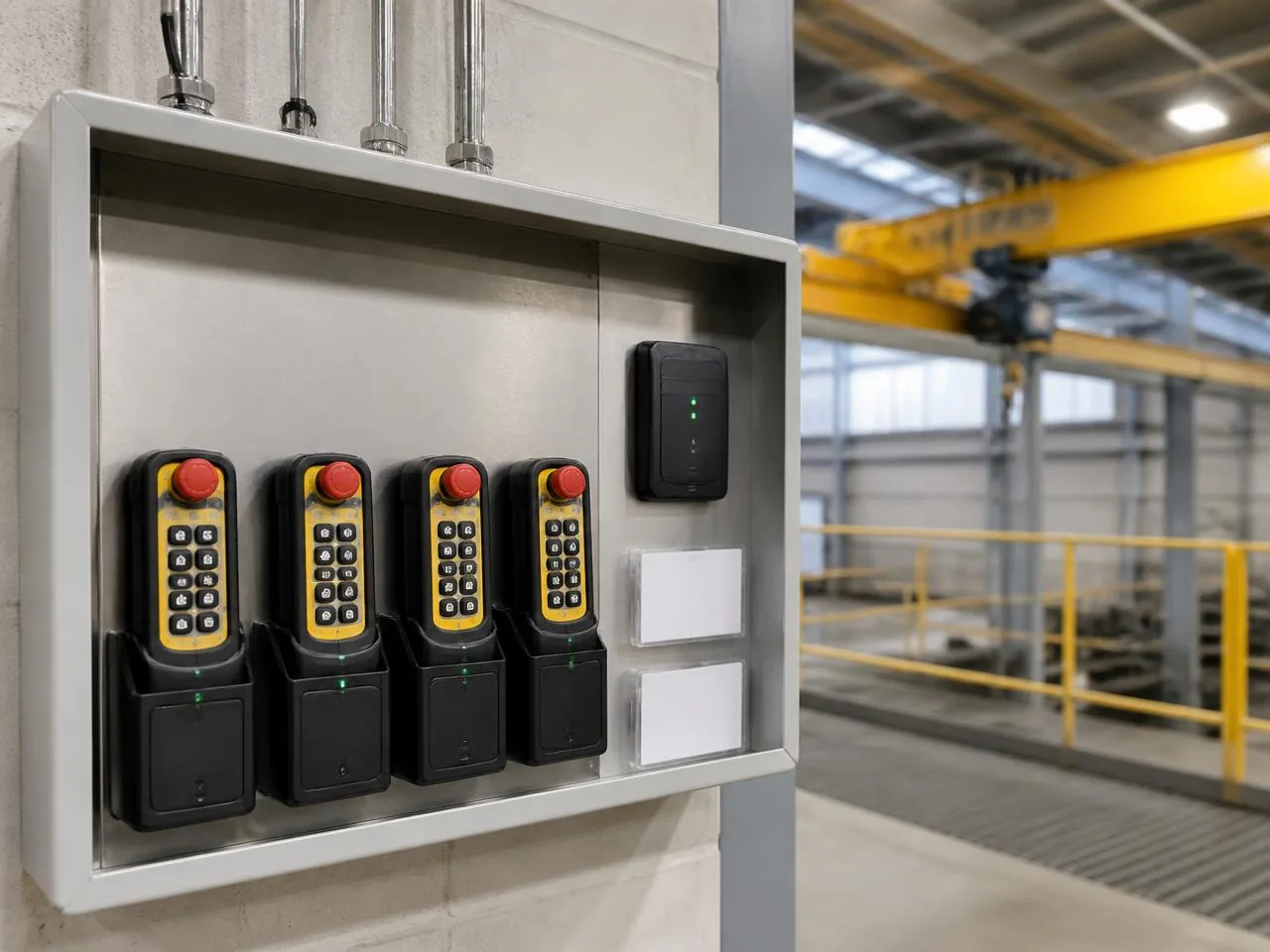
- Pendant or remote cradle reader. The operator taps the card on a reader mounted at the crane's main disconnect, pendant station, or remote-control charging dock. The crane's control relay is held open until authentication succeeds.
- On-board controller integration. The RFID module talks to the crane's PLC or variable-frequency drive. This allows per-operator speed limits, restricted zones, and load-capacity checks.
- Facility-wide access system tie-in. The crane reader is added as another node on the plant's existing employee badge system. One card governs doors, machines, and cranes.
Most retrofits use option 1 or 2. Option 3 is attractive for large sites that already badge every employee.
What to specify
If you are buying or modernizing an overhead crane and want RFID access control, put these items in the specification:
- Card format and compatibility with your existing plant badge system.
- Fail-safe behavior — what happens if the reader loses power or communication.
- Offline operation for cranes in areas with weak network coverage.
- Operator qualification rules — training expiry, medical certificate expiry, crane-class authorization.
- Audit log retention — at least the duration required by your jurisdiction and insurance policy.
- Reporting exports in CSV or API format for integration with your maintenance or HR systems.
- Tamper detection on the reader enclosure and control relay.
Integration with inspection and maintenance programs
RFID logs do not replace inspections, but they make inspection programs more targeted. If one crane has twice the logged usage of an identical crane in the next bay, it likely needs more frequent hook, brake, and rope checks. Access data turns a calendar-based maintenance program into a usage-informed one.
The same logs help justify training budgets. If operators repeatedly fail to log out or share cards, that is a training and policy issue — and the data makes the case visible to management.
Compliance context: CSA B167 and ASME B30
CSA B167-16 (and the upcoming CSA B167-26) requires that crane operators be trained and competent for the equipment they operate. ASME B30.2 and B30.17 contain similar operator qualification language. Neither standard mandates RFID specifically, but both expect the owner to be able to demonstrate that only qualified persons operate the crane.
RFID access control is one of the most defensible ways to make that demonstration. It is a preventive control, not a record-keeping afterthought.
Common objections and responses
"It will slow operators down." A tap takes less than a second. The real delay is hunting for a shared pendant or waiting for a supervisor to authorize an unbadged operator.
"Operators will just share cards." Pair the card with a PIN or biometric check for high-risk cranes. Policy plus consequences for card sharing usually eliminates the behavior quickly.
"Our cranes are too old." Retrofit kits are available for most pendant and radio-controlled cranes. The older the crane, the more value there is in controlling who runs it.
"It is expensive." A retrofit is typically a small fraction of one lost-time incident or one day of unplanned crane downtime. On multi-crane sites, the per-unit cost drops sharply.
When to engage CAG
If you are unsure whether RFID access control fits your crane fleet, CAG can assess your current controls, define the functional specification, and review vendor proposals against your safety and production requirements. We do not sell hardware — we help owners buy the right overhead crane and material handling controls for their operation.
Send your questions to advice@craneadvisorygroup.ca.
FAQ
Frequently asked questions
- Can RFID access control be retrofitted to existing overhead cranes?
- Yes. Most pendant and radio-controlled overhead cranes can be fitted with an RFID reader that interrupts the control circuit until a valid card is presented. The level of integration depends on the crane's existing controls.
- Does RFID access control replace operator training?
- No. It enforces training. The system checks that the operator's qualification is current, but it does not teach the operator how to run the crane. Training, evaluation, and refresher programs remain required under CSA B167 and ASME B30.
- What happens if an operator loses their card?
- The card is deactivated immediately and a replacement is issued. Most systems allow a temporary supervisor-authorized override, but that override is logged with the supervisor's ID and reason.
- Will RFID access control work without a network connection?
- Many systems store authorized cards locally and sync when connected. For remote or mobile cranes, specify offline-capable readers with periodic upload to the central database.
- How does RFID help after a crane incident?
- The access log shows exactly who was logged into the crane and when. That evidence is valuable for internal investigations, regulatory interviews, insurance claims, and corrective-action planning.
Related services
How CAG helps on this
overhead crane preventive maintenance program
Overhead Crane Maintenance, Inspection & Service Program Review
Read moreoverhead crane inspection program consultant
Overhead Crane Inspection Program Consultant
Read moreoverhead crane modernization consultant
Overhead Crane Modernization Consultant
Read more
Related industries
Industry pages worth reading next
More field notes
10 min · Overhead Crane
Vacuum Lifters vs. Magnet Lifters: Choosing the Right Below-the-Hook Attachment for Your Overhead Crane
8 min · Overhead Crane
Overhead Crane Load Testing and Commissioning Requirements: A Practical Guide
9 min · Maintenance
Who Should Define Your Overhead Crane Maintenance Scope — the Owner or the Service Contractor?