Hazardous Location Overhead Cranes: Class I Div 1 vs Div 2, Gas Groups, and Explosion-Proof Certification
A practical guide to explosion-proof overhead cranes for Class I Division 1 and Division 2 locations. Covers NEC/CEC classification, gas groups A/B/C/D, protection techniques, and a procurement checklist.
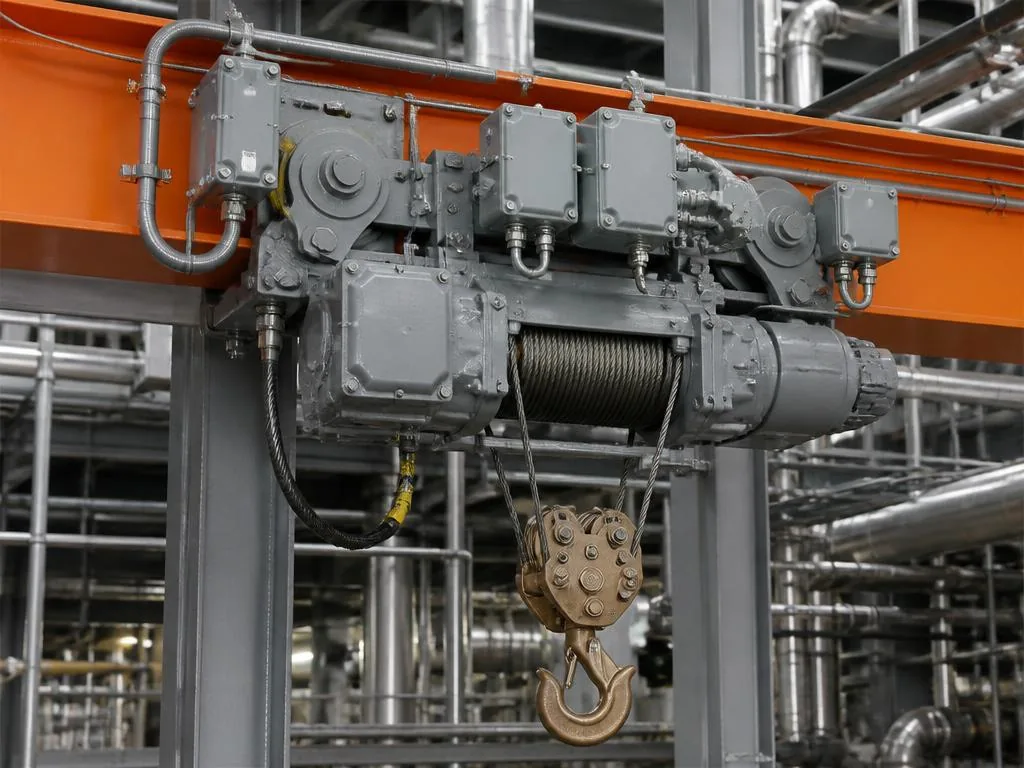
A standard overhead crane is not allowed in a hazardous location just because it is painted yellow and has a heavy-duty motor. The electrical enclosure, motor, brakes, controls, festooning, and even the pendant station must be certified for the specific gas or vapor hazard present. Get the classification wrong and the crane fails inspection, invalidates insurance, or creates an ignition risk in a facility that cannot tolerate one.
This guide explains how hazardous location classification works for overhead cranes in North America: the difference between Class I Division 1 and Division 2, what the gas groups A, B, C, and D actually mean, the protection techniques used on explosion-proof and non-incendive equipment, and what to specify when you buy or modernize a crane for a classified area.
What makes a crane "hazardous location" rated?
A hazardous location crane is a crane whose electrical and mechanical components are rated, labeled, and installed for the specific flammable atmosphere defined by the area classification. The rating is not a marketing label. It is a code-driven requirement under:
- NFPA 70 / Canadian Electrical Code — area classification rules
- NFPA 497 / C22.2 No. 213 — recommended practice for classifying flammable atmospheres
- UL 1203 / CSA C22.2 No. 30 — explosion-proof and dust-ignition-proof enclosures
- UL 913 / CSA C22.2 No. 157 — intrinsically safe apparatus
- ANSI/NFPA 70 Article 500 / CEC Section 18 — installation requirements
For cranes, the most common concern is Class I — flammable gases or vapors in quantities large enough to produce explosive mixtures with air. Class II (combustible dust) and Class III (ignitable fibers) also exist, but Class I is where most overhead crane questions arise.
Class I, Division 1 vs. Class I, Division 2
The division tells you how likely the hazardous atmosphere is to be present.
| Classification | Definition | Typical crane application |
|---|---|---|
| Class I, Division 1 | Hazardous atmosphere exists under normal operating conditions, or exists frequently because of repair, maintenance, or leakage. | Inside process areas, open tanks, loading racks, compressor houses, areas where vapors are normally vented. |
| Class I, Division 2 | Hazardous atmosphere exists only under abnormal conditions — rupture, spill, equipment failure, or improper operation. | Adjacent to Division 1 boundaries, storage warehouses, areas where flammable liquids are handled in closed systems. |
A crane in Division 1 must be built so that any internal explosion is contained and cooled before gases escape the enclosure — this is the explosion-proof approach. A crane in Division 2 can often use non-incendive or purged/pressurized equipment because the hazard is not normally present.
The division is determined by the facility's area classification drawing, not by the crane vendor. The vendor builds to the drawing. If your classification is wrong, the crane is wrong.
Gas Groups A, B, C, and D explained
Within Class I, the gas group identifies the ignition energy and flame temperature of the hazardous gas. Equipment must be marked for the group it is certified to handle. A higher-letter group covers lower-letter groups in terms of stringency, but the label must match or exceed the actual gas.
| Group | Representative gases | Characteristics | Crane equipment implication |
|---|---|---|---|
| A | Acetylene | Very low ignition energy, high flame temperature | Rare for cranes; requires specially rated components and installation. |
| B | Hydrogen, butadiene, ethylene oxide | Low ignition energy, high flame temperature | Found in refineries and chemical plants; enclosures must be designed for these gases. |
| C | Ethylene, cyclopropane, ethyl ether | Moderate ignition energy | Common in petrochemical and plastics plants. |
| D | Propane, gasoline, naphtha, methane, natural gas | Highest ignition energy of the four groups | Most common group for overhead cranes in oil and gas, LNG, and general chemical handling. |
If your area classification calls for Class I, Division 1, Group C, equipment labeled only for Group D is not acceptable. If it is labeled for Groups C and D, it is acceptable because the certification covers the more severe group. Always confirm the equipment nameplate matches the area classification drawing.
Protection techniques used on hazardous location cranes
Crane vendors use several methods to make electrical equipment safe in classified areas. The right method depends on the division and the component.
Explosion-proof enclosures (Division 1) The enclosure is designed to withstand an internal explosion and cool the escaping gases through flame paths so they do not ignite the surrounding atmosphere. Motors, control boxes, junction boxes, brakes, and limit switches can all be explosion-proof. This is the heaviest and most expensive approach, but it is the standard for Division 1.
Intrinsically safe circuits (Division 1 and 2) The circuit is designed so that even under fault conditions it cannot release enough energy to ignite the gas. Common for low-power controls, sensors, and pendants. Intrinsically safe circuits must be separated from non-intrinsically safe circuits and use approved barriers.
Non-incendive equipment (Division 2 only) Equipment that under normal operation does not produce arcs, sparks, or hot surfaces capable of ignition. It is lighter and less expensive than explosion-proof, but it is only permitted in Division 2 because it is not designed to contain an internal explosion.
Purged and pressurized systems (Division 1 and 2) Clean air or inert gas is maintained inside an enclosure at a pressure slightly above atmospheric, preventing hazardous gas from entering. Loss of purge pressure must trigger an alarm or shutdown. Used for large control panels, operator cabs, and VFD enclosures.
Increased safety (Exe / Division 2) A construction method that prevents arcs, sparks, or excessive temperatures under normal operation. Common in IECEx/ATEX markets and increasingly referenced in Canadian projects.
Crane-specific hazardous location considerations
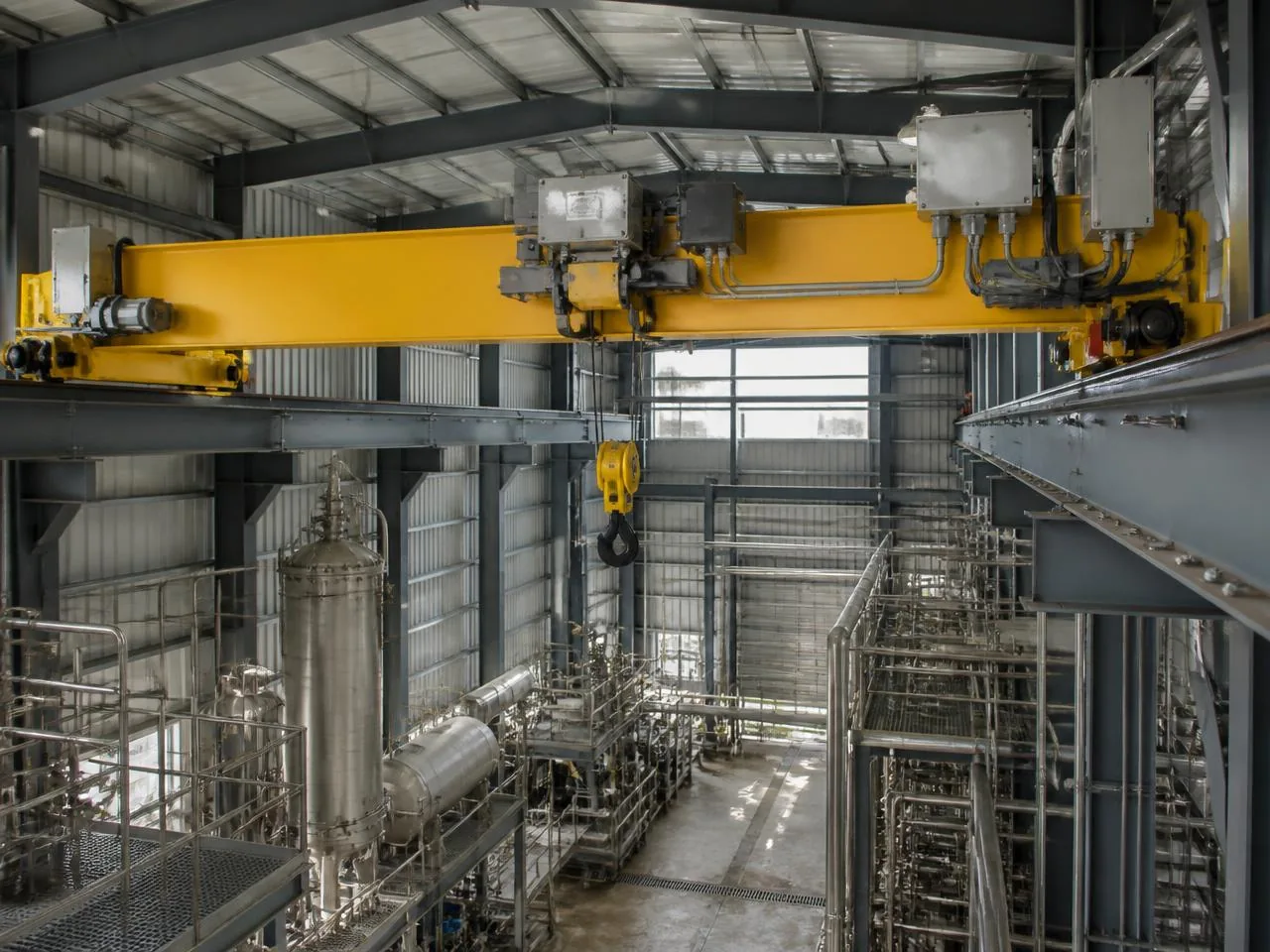
Buying a hazardous location crane is not just about ordering an "explosion-proof motor." Every electrified subsystem matters.
- Motors and brakes: Must be rated for the class, division, and group. Brake coils and rectifiers are common ignition sources if not properly enclosed.
- Control panels and VFDs: Often purged or housed in explosion-proof enclosures. Heat dissipation becomes a real problem; confirm ambient temperature ratings and cooling.
- Festooning and power feed: Cables must be rated for the environment, properly sealed at entries, and supported so they are not damaged by movement or abrasion.
- Pendant and radio controls: Pendants may be intrinsically safe or housed in sealed enclosures. Radios must be certified for the hazardous location and cannot introduce ignition sources through battery or antenna faults.
- Limit switches and load cells: These low-power devices are easy to overlook but must carry the same area classification rating as the crane.
- Conductive surfaces and bonding: Proper grounding and bonding prevent static discharge, which can be an ignition source in itself.
NEC/CEC vs. ATEX/IECEx
North American projects use Class/Division/Group labeling under the NEC or CEC. International projects, and some Canadian owners with global standards, use the Zone system from ATEX and IECEx:
| NEC/CEC | IECEx/ATEX | Rough equivalence |
|---|---|---|
| Class I, Division 1 | Zone 0 / Zone 1 | Zone 0 is more severe than Division 1 in some respects |
| Class I, Division 2 | Zone 2 | Similar intent |
| Groups A/B/C/D | Gas Groups IIA/IIB/IIC | IIC covers hydrogen and acetylene; maps roughly to Groups A/B |
If you are procuring for a facility that references both systems, specify which certification is required and who bears the cost of dual certification. Do not assume a Zone 2 crane is automatically acceptable in a Division 2 area without local approval.
Procurement checklist for a hazardous location crane
Use this checklist before issuing the enquiry or reviewing bids:
- Confirm the latest area classification drawing and the specific Class, Division, and Group for the crane's operating envelope.
- Define the ambient temperature range, corrosive exposure, and duty class — hazardous location ratings do not replace CMAA/CSA duty class requirements.
- Require nameplate photos and third-party certification documents (UL, CSA, FM, or IECEx/ATEX as applicable) as submittals.
- Specify whether Division 1 or Division 2 protection is required for each subsystem; do not leave it to the vendor to interpret.
- Require sealed conduit, cable glands, and entry fittings rated for the same classification as the enclosure.
- Ask for a spare-parts recommendation focused on seals, gaskets, brake coils, and certified replacement motors.
- Include commissioning and acceptance testing requirements: insulation resistance, ground continuity, purge alarm testing, and witnessed operation.
- Confirm who performs the final area classification verification — the electrical contractor, the vendor, or a third-party inspector.
When to bring in an independent consultant
Hazardous location crane specifications sit at the intersection of electrical code, mechanical design, process safety, and vendor capability. A vendor-neutral consultant can help you:
- Validate the area classification against the actual crane scope before procurement
- Write a technical specification that does not over-specify Division 1 equipment in a Division 2 area
- Review vendor submittals for certification gaps
- Witness factory acceptance and site commissioning
- Avoid change orders when the inspector rejects equipment that does not match the nameplate
If you are planning a crane for a classified area, get in touch before the enquiry goes out. The right classification at the front end saves far more than it costs.
Where CAG fits
We help owners specify, procure, and commission hazardous location overhead cranes without selling equipment. That means the classification, duty class, protection technique, and vendor submittals we review are chosen for your risk profile, not a vendor's product line. See specification review, procurement advisory, and inspection services for how we support classified-area crane projects.
Related reading: heavy-duty crane duty, coating and hazardous-area specifications.
FAQ
Frequently asked questions
- Can I use a Division 2 crane in a Division 1 area?
- No. Division 2 equipment is not designed to contain an internal explosion and is not permitted where hazardous atmospheres are normally present. Division 1 areas require explosion-proof, intrinsically safe, or other Division 1 approved protection methods.
- What is the difference between Class I and Class II hazardous locations?
- Class I covers flammable gases and vapors. Class II covers combustible dusts. Class III covers ignitable fibers and flyings. Overhead cranes in chemical, petrochemical, and oil-and-gas plants are typically Class I concerns.
- Does an explosion-proof crane need special maintenance?
- Yes. Explosion-proof enclosures rely on intact flame paths, gaskets, seals, and bolt torque. Maintenance must use certified replacement parts, preserve surface finishes, and avoid modifications that void the certification. Inspection programs should include enclosure condition, conduit sealing, and ground continuity.
- Which gas group is most common for overhead cranes?
- Group D — which includes propane, gasoline, naphtha, methane, and natural gas — is the most commonly encountered group for overhead cranes in oil and gas, LNG, and general chemical handling. Group C is common in petrochemical and plastics plants. Groups A and B are less common but require the most stringent equipment ratings.
- Can a standard VFD be used in a hazardous location?
- Only if the VFD is rated and installed for the classified area. In Division 1, VFDs are typically housed in explosion-proof enclosures or in a purged/pressurized panel. In Division 2, non-incendive or purged VFDs may be acceptable. Heat rejection and ambient temperature ratings must also be verified.
- Who determines the hazardous location classification for a crane?
- The facility's area classification drawing is produced by the owner or the owner's engineer, typically based on NFPA 497 or C22.2 No. 213. The crane vendor builds to that classification. If the drawing is outdated or the crane's operating envelope has changed, the classification should be revalidated before procurement.
Related services
How CAG helps on this
overhead crane specification review
Overhead Crane Specification Review
Read moreoverhead crane procurement consultant
Overhead Crane Procurement Consultant
Read moreoverhead crane inspection program consultant
Overhead Crane Inspection Program Consultant
Read moreoverhead crane modernization consultant
Overhead Crane Modernization Consultant
Read moreoverhead crane bid review
Overhead Crane Bid Review
Read more
More field notes
7 min · Alberta
Alberta's Two Landmark Builds: The Sturgeon Refinery and the Heartland Petrochemical Complex
6 min · Asset Management
Overhead Crane Asset Management in Mining, Steel and Refining: Who Is Actually Managing the Fleet?
9 min · Maintenance
Who Should Define Your Overhead Crane Maintenance Scope — the Owner or the Service Contractor?