Motors, Gearboxes and Gearing: The Obsolete Parts That Keep Cranes Down for Weeks
Crane motors, gearboxes, gears and pinions can be reverse engineered — but it takes weeks to months. Why preventive maintenance and a critical spares strategy let you budget before the part disappears.
How Crane Advisory Group Helps
Reading the standard is the easy part. Applying it to your cranes is the job.
Crane Advisory Group is an independent overhead crane and material handling consultancy led by Bryan Whitty, Founder & Principal Consultant, with 15+ years in the crane industry. We don't sell cranes, parts or service contracts — so what you get back is a recommendation, not a quote.
Compliance Gap Review
Where your maintenance, inspection and records program actually sits against the CSA B167 edition your province names — documented in writing.
Specs, Bids & Quotes Reviewed
Duty class, options, scope and exclusions checked before you sign — so you buy the crane or contract you need, not the one that was easiest to quote.
Independent Second Opinion
Repair, replace or modernize — reviewed by someone with no equipment, parts or service contract riding on the answer.
- In the overhead crane industry
- 15+ yrsIn the overhead crane industry
- Equipment, parts or service margin
- 0%Equipment, parts or service margin
- Standards referenced: CSA B167 · CMAA · ASME B30
- 3Standards referenced: CSA B167 · CMAA · ASME B30
- Scope and fee agreed before work starts
- FixedScope and fee agreed before work starts
Free download: CSA B167 Overhead Crane Compliance Checklist
A 5-page, vendor-neutral self-audit covering jurisdiction and edition, crane register, maintenance program, inspections and records, structure, electrical, training, modifications and vendor oversight. Enter your work email and the PDF opens immediately.
No newsletter spam. Every engagement follows the same documented review process.
See how an engagement worksA different cost structure than asking your crane supplier. Our work is advisory-only and scoped and quoted before it starts. There is no equipment margin, parts markup or service agreement attached to the advice — and a scoped review is a small line item next to the capital purchase, modernization or multi-year contract it is reviewing.
Quick answer: The parts that put aging cranes out of service for weeks are mechanical — hoist and travel motors, gearboxes, gears and pinions. Unlike electronics, these can almost always be reverse engineered and machined, and the major crane manufacturers openly offer that service. That is exactly what makes obsolescence feel manageable until it isn't. Because a solution exists on paper, nobody stocks the spare — and then the failure arrives and the "solution" turns out to take months and cost several times what a shelf part would have. Preventive maintenance is how you see it coming while you still have options, and while the fix is a budget line rather than an emergency.
The part that fails is rarely the part you were watching
A hoist gearbox develops a noise. Oil analysis has been showing rising iron content for a couple of quarters, but the crane keeps running, so nothing gets escalated. Then a pinion loses teeth on a Thursday afternoon.
Teardown finds the damage. Someone calls the manufacturer. The hoist model was discontinued fourteen years ago, no gear sets remain, and the original drawings either don't exist or belong to a company acquired twice since the crane was installed.
Here is where mechanical obsolescence differs from every other kind. Nobody tells you it's impossible. They tell you it's possible — the pinion can be reverse engineered and cut new. The large manufacturers advertise precisely this capability, and they can genuinely deliver it.
So you say yes. And then you find out what that involves.
Reverse engineering is real — and it is not fast
It's worth being fair about this, because the capability is legitimate. Reverse engineering isn't a compromise; done properly it can improve on the original. Material grades, heat treat processes and manufacturing methods have all advanced since a 1980s gear set was cut, and a replacement engineered today can outlast the part it replaces. The major crane manufacturers offer this for gears, shafts, drums and hooks across any make and model, and it is often the correct technical answer.
The problem isn't quality. It's the calendar.
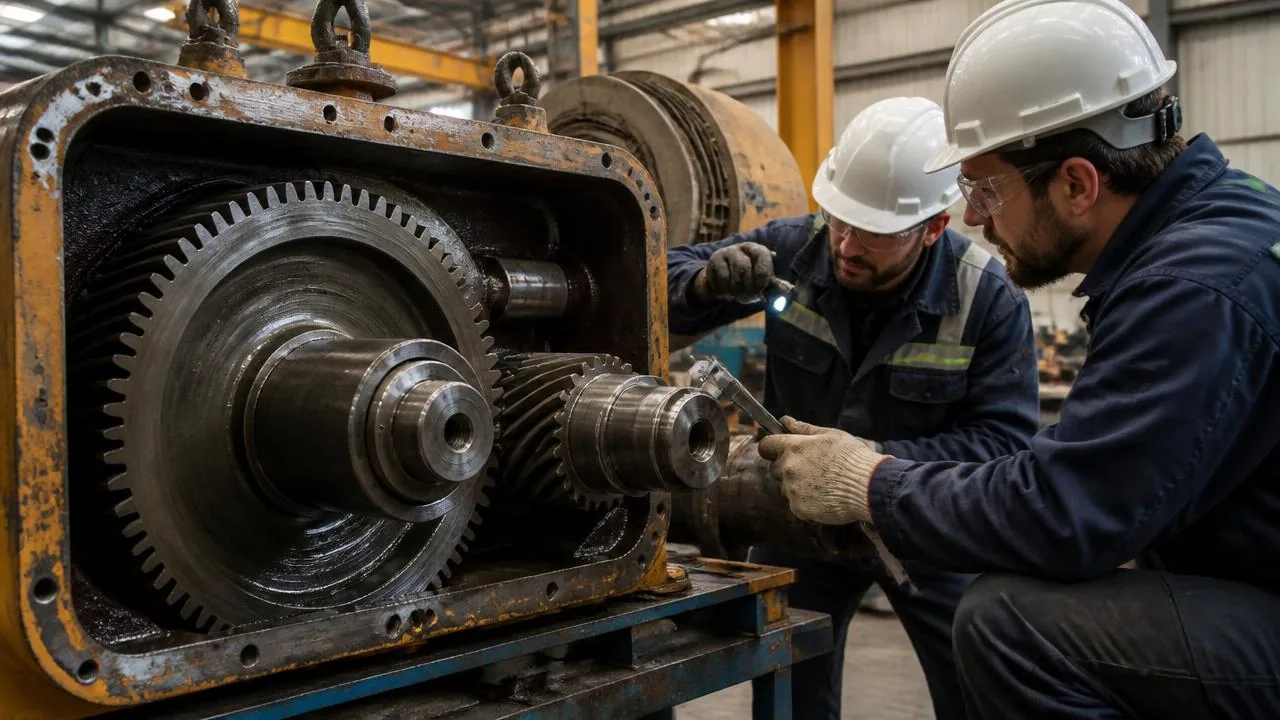
Machining a replacement gear or pinion is not a machining job. It's a small engineering project, and every stage has a queue in front of it.
Dimensional and tooth geometry inspection. Not just diameters and bores — module or diametral pitch, pressure angle, helix angle, face width, profile shift, backlash allowance. Specialist work, and harder on a broken part. Where teeth are missing or the failure surface is destroyed, geometry has to be inferred from the mating gear, which introduces error into everything downstream.
Material and heat treat determination. A crane gear is a specific alloy with a specific case depth and core hardness, usually carburized and hardened. Wrong material or wrong heat treat produces a part that looks right and fails early — sometimes taking the mating gear with it. Determining the original spec means material analysis and hardness traverse testing, which means a lab, which means time.
Blank procurement. Forgings and large-diameter blanks are not shelf items at crane gearing sizes. Four to twelve weeks depending on size and material, entirely outside your control.
Cutting, heat treat and finishing. Hobbing or shaping, then carburizing and hardening, then grinding to final geometry — frequently at three different facilities, each with its own backlog. Heat treat queues in particular cannot be expedited.
Inspection and fitting. Verification against the reverse-engineered specification, then fitting into a housing with its own decades of wear in the bearing bores and shaft fits.
Realistically: eight to twenty weeks, assuming nothing goes wrong. Longer for large hoist gearing or ambiguous geometry.
And on cost: a one-off reverse-engineered gear set routinely runs several times the price of an equivalent production part, because engineering, inspection, lab work and tooling setup are all absorbed by a single unit. You pay more and wait months for something that would have cost less and shipped in days if it had been ordered while it was still catalogued.
That is the entire argument for a spares strategy. Not that reverse engineering is bad — it's that it is a planned-project solution being used as an emergency response. The same logic applies to hoist and crane spare parts more broadly.
Motors: the same problem in different clothing
Crane duty motors are not general-purpose industrial motors, and substitution is rarely as simple as matching horsepower and voltage.
Duty rating. Built for high starting torque and frequent starts and stops on intermittent duty. A standard-duty motor at the same nameplate rating will not survive the application.
Mechanical interface. Frame size, mounting arrangement, shaft diameter and extension, keyway, flange pattern and brake mounting are often specific to the crane builder's design. A modern motor with the right electrical rating may not physically fit, or may fit while shifting brake mounting or coupling alignment.
Wound rotor motors. Common on older cranes with resistance control, largely out of production. Replacement usually means converting to a squirrel cage motor with a VFD — a good long-term outcome, but a control system project with engineering, procurement and commissioning attached, not a motor swap.
Brake integration. Where the brake is integral to the motor, losing the motor means losing the brake solution too.
Motors can be rewound, and competent shops do good work. But rewinding a burned stator is a different proposition from a motor with damaged laminations or a failed rotor, and turnaround on crane duty motors runs weeks rather than days.
Gearboxes: the housing is usually the real constraint
Gearbox obsolescence is rarely about the gearing alone. It's about the housing, which carries bearing bores, shaft centres and mounting interfaces designed around that specific crane. When internals are unavailable, the options are:
Rebuild with reverse-engineered internals — the eight-to-twenty-week path above, applied to several components at once.
Retrofit a modern gearbox — new mounting arrangements, possibly a new motor and coupling, sometimes structural modification to the trolley or bridge, plus engineering sign-off. Weeks of design before anything is ordered.
Source a used unit — fastest, but unknown internal condition and no warranty. Reasonable as a bridge, risky as the permanent answer.
A cracked housing, or bearing bores worn past repair limits, removes the first option entirely.
One point worth taking seriously: when a gear or pinion is replaced individually, the new part meshes with a mating gear carrying decades of wear. Surfaces that have matched each other for thirty years no longer do, and replacing half a set frequently shortens the life of both halves. Plan mechanical replacement as a set, not as a part.
Why the nameplate on your crane may not help you
The crane industry has consolidated heavily. Kaverit Cranes & Service, a Canadian market leader for close to thirty years, became part of Konecranes in 2006. Provincial and P&H followed similar paths. Columbus McKinnon now holds Coffing, Budgit, Shaw-Box, Yale, Abell Howe, Chester, Little Mule and Duff Norton.
Many Canadian plants are running cranes built by companies that no longer exist independently. Support for those legacy lines often continues — the acquiring manufacturers do stock parts for absorbed brands, and that's genuinely useful. But legacy support is a business decision, not a commitment, and it narrows over time. Depth of stock for a brand acquired twenty years ago is not the depth of stock for a current product line.
The practical implication: the fact that someone answers the phone for your crane's brand does not mean the part you need is on a shelf. That has to be verified for the specific part number, and re-verified periodically.
What preventive maintenance should be catching
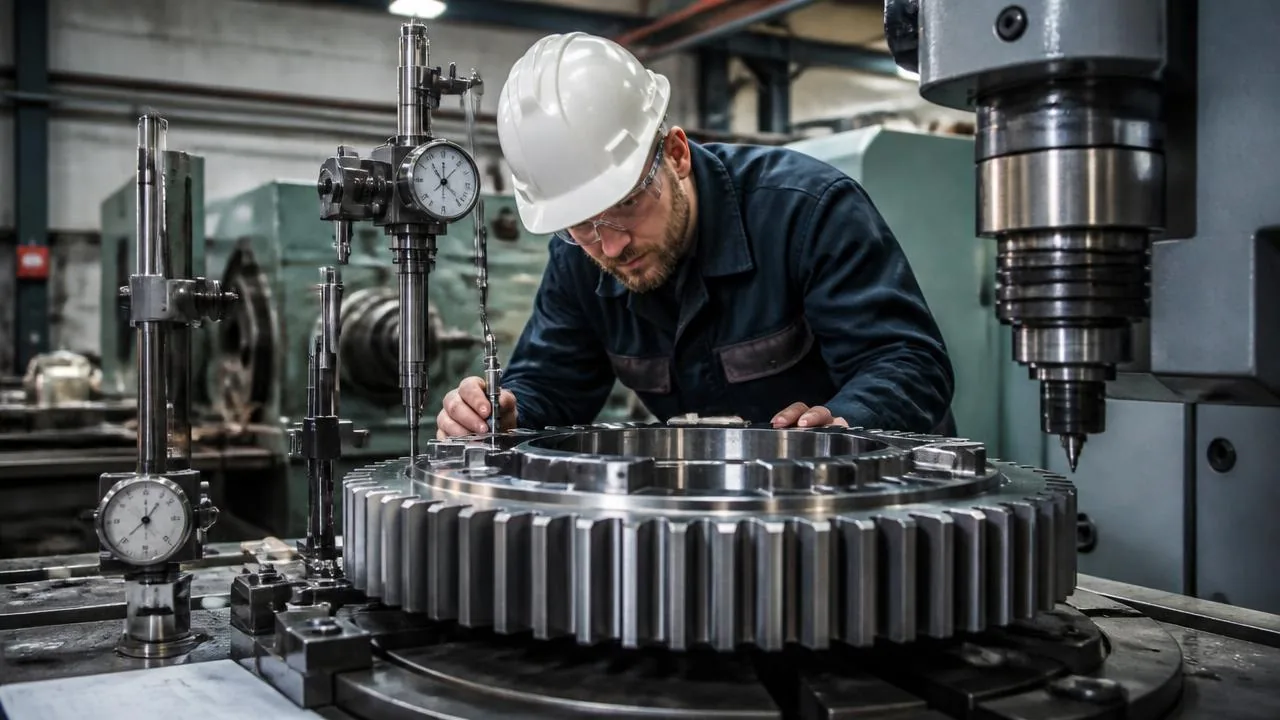
The value of a PM program here isn't that it prevents wear — gears wear. It's that mechanical wear announces itself well in advance, measurably, and that warning is what converts an emergency into a budget line.
For each significant drivetrain component, a program built for planning should capture and trend:
Oil analysis on every gearbox — particle count, wear metals, viscosity, water content. Rising iron or specific wear metals is the earliest reliable signal, typically appearing quarters before failure.
Vibration analysis on hoist and travel drives, trended rather than spot-checked. Gear mesh frequencies and sidebands identify developing tooth problems specifically.
Backlash measurement at consistent points over time. A single reading means little; a trend means a lot.
Visual tooth inspection through inspection covers — pitting, spalling, scoring, and whether the contact pattern has shifted across the face.
Motor condition — insulation resistance trending, bearing temperature, current draw under known load, brake wear rate.
Bearing endplay and shaft alignment, particularly after coupling work.
Alongside the condition data, for each component: manufacturer, model, installation date, current availability, current lead time, and whether a like-for-like replacement still exists.
That last group is what most inspection reports omit. A compliance inspection tells you the gearbox is serviceable. A program built for planning tells you the gearbox is serviceable, that iron content has tripled across three samples, that the hoist model was discontinued in 2016, and that no gear sets remain in the channel. Whether your inspection program produces one or the other usually comes down to how the maintenance scope was defined in the first place.
The first finding closes out. The second one funds a capital request.
Which mechanical spares are actually worth stocking
Drivetrain spares are expensive and physically large, so the test has to be strict. A component earns critical-spare status when all three are true:
Failure stops something that matters. A maintenance bay crane down three weeks is an inconvenience. A furnace charging crane or a production-line hoist down three weeks is a plant problem.
Recovery time exceeds what you can absorb — and for reverse-engineered gearing, recovery is months.
No workable interim exists. No redundant crane covering the bay, no degraded mode, no rental or temporary arrangement that fits.
Applied honestly, the list is short: usually the hoist gearbox or gear set on your one or two genuinely critical cranes, plus the hoist motor where the model is already unavailable.
Two practical points. For a component already discontinued, buying now may be your last opportunity to buy at all — and storing a gear set for five years costs almost nothing against a three-month outage. And spares need real storage: preserved against corrosion, correctly oriented, with part number, drawing reference and any inspection certification stored alongside. A gear set that turns out to be the wrong revision, or that has surface-rusted on a bearing journal, has cost money and delivered nothing.
Modernization is usually cheaper than the panic
When the drivetrain becomes unsupportable, the instinct is to price a new crane. Often that's the wrong comparison.
Industry figures for control and drive system retrofits put them at roughly 15 to 30 percent of the cost of a new crane, with the crane out of service around 7 to 10 days for installation and commissioning. Mechanical modernization varies more, but the pattern holds: where the structure is sound — and on a normal-duty crane at thirty years it frequently is — rebuilding the drivetrain on the existing bridge delivers a supportable crane for a fraction of replacement cost, with a far shorter outage. That is the repair, modernize or replace comparison, and it deserves to be made deliberately.
But that comparison only exists while you still have a choice. A facility that plans a modernization can scope it, tender it competitively, sequence it into a shutdown and commission it properly. A facility reacting to a failed unsupported gearbox gets whatever can be done fastest, from whoever is available, at a premium.
Making the budget case before the failure
A functioning crane is a hard thing to request capital for. "The gearbox still works, but the internals are unavailable" competes poorly against projects with visible returns — until it fails, at which point the money appears instantly, at emergency pricing, with no time to evaluate anything.
A capital request that gets funded early is built on evidence, not urgency:
Quantify the exposure in outage terms. Not "the crane is old," but: this crane supports X hours of production per week; the hoist gear set is unavailable; reverse engineering is realistically twelve to sixteen weeks; here is that cost against acting now.
Show the trend. Three oil samples with rising wear metals is an argument. One report saying "serviceable" is not.
Present the real options — stock the spare, rebuild proactively during a planned outage, modernize the drivetrain, replace the crane — each with cost, duration and risk. A recommendation is more credible when the rejected alternatives are visible.
Phase the spend. Buy the critical spare this year, schedule the rebuild in two. Far more fundable than one large ask, and it removes the outage risk immediately.
Sequence into planned shutdowns. Drivetrain work inside an existing outage costs a fraction of the same work as an emergency — itself a strong argument for approving it early.
Where Crane Advisory Group fits
Everything above can be done by a facility on its own, and some do it well. Where owners typically get stuck is not the technical work — it's that the people best placed to advise on it are also the people selling the parts.
That isn't an accusation. Manufacturers and service providers do good work and their reverse engineering capability is real. But a supplier's assessment naturally runs through what they can supply, and their scope ends at a quotation. Nobody in that chain is paid to tell you which of your forty cranes actually justifies a stocked gear set, or that the right answer this year is to defer.
Crane Advisory Group works on the owner's side of that question:
Fleet criticality ranking — which cranes genuinely warrant spares and priority, based on what stops if they stop, rather than treating every crane the same.
Obsolescence exposure review — establishing, per crane, which drivetrain components are still available, which are legacy, and which are already unsupported, and what recovery would actually look like for each.
Critical spares strategy — a defensible, costed list of what to hold and what not to, tested against the criticality, lead time and workaround criteria above.
PM scope review — assessing whether your current inspection program is producing planning data or only compliance data, and specifying what to add so it produces both.
Repair, modernize or replace assessments — an independent evaluation with the options priced and compared, including the option of doing nothing yet.
Capital planning support — turning condition and availability data into a phased, evidence-based budget case that survives scrutiny.
Quote and proposal review — where a rebuild, reverse engineering or modernization has been quoted, an independent read on whether the scope, lead time and price are reasonable.
We sell no equipment, no parts and no service. Our only revenue from an engagement is the advisory fee, so there is no version of our advice that pays us more.
If you have cranes you suspect are running on components you can no longer buy, that's worth establishing before a Thursday afternoon establishes it for you.
FAQ
Frequently asked questions
- How long does it actually take to reverse engineer a crane gear or pinion?
- Typically eight to twenty weeks from failed part to installed replacement, and longer for large hoist gearing or where original geometry is unclear. The stages are dimensional and tooth-geometry inspection, material and heat treat determination, blank procurement, cutting, heat treat, grinding, and inspection — most at separate facilities, each with its own queue.
- Is a reverse-engineered gear as good as the original?
- It can be better. Material grades and heat treat processes have advanced, and a part engineered today can outlast what it replaces. The risk sits in the specification, not the machining — an incorrect case depth or material grade produces a part that looks right and fails early. Insist on documented material certification and hardness verification.
- Can we just replace the failed pinion and leave the mating gear?
- Possible, but it often shortens the life of both. Mating gears develop matched wear patterns over decades, and a new part meshing with a worn one carries uneven contact. Where budget allows, replace gearing as a set.
- Can crane motors be substituted with a standard industrial motor?
- Usually not directly. Crane duty motors are built for high starting torque and frequent starts and stops, and frame size, shaft dimensions, mounting and brake interface are often manufacturer-specific. Substitution generally needs engineering review, and for wound rotor motors it typically means converting to a VFD-driven squirrel cage motor — a control system project rather than a swap.
- Our crane was built by a company that got acquired. Are parts still available?
- Often yes — acquiring manufacturers commonly continue supporting legacy brands and stock parts for them. But legacy support narrows over time and depth of stock is not the same as for a current product line. Verify availability for the specific part number rather than assuming brand-level support covers it, and re-check periodically.
- Our contractor does our inspections. Shouldn't they be flagging obsolescence?
- Many will if asked, but a standard inspection is scoped to assess condition against wear limits, not parts availability. If you want obsolescence and lead-time tracking, it generally has to be written into the scope of work.
- Does replacing drivetrain components trigger inspection or documentation requirements?
- Changes affecting drive arrangement, braking or structural configuration generally require documentation and re-commissioning verification, and requirements vary by jurisdiction. Confirm scope before work begins, not after.
Related services
How CAG helps on this
overhead crane repair or replace assessment
Overhead Crane Repair-or-Replace Assessment
Read moreoverhead crane preventive maintenance program
Overhead Crane Maintenance, Inspection & Service Program Review
Read moreoverhead crane asset management
Overhead Crane Asset Management
Read moreIndependent second opinion
Independent Second Opinion on Crane Quotes and Recommendations
Read more
Related industries
Industry pages worth reading next
More field notes
9 min · Maintenance
Who Should Define Your Overhead Crane Maintenance Scope — the Owner or the Service Contractor?
10 min · Service Contracts
Before You Renew Your Crane Service Contract: 10 Questions Owners Should Ask
7 min · Maintenance
Why a Hoist Spare-Parts Strategy Matters: Motors, Wire Rope, Brakes and Rope Guides