Crane Service Contract vs. Crane Maintenance Program: What's the Difference?
A crane service contract provides inspections, repairs and labour. A maintenance program defines what should be maintained, how often, how deficiencies are managed and how reliability is measured.
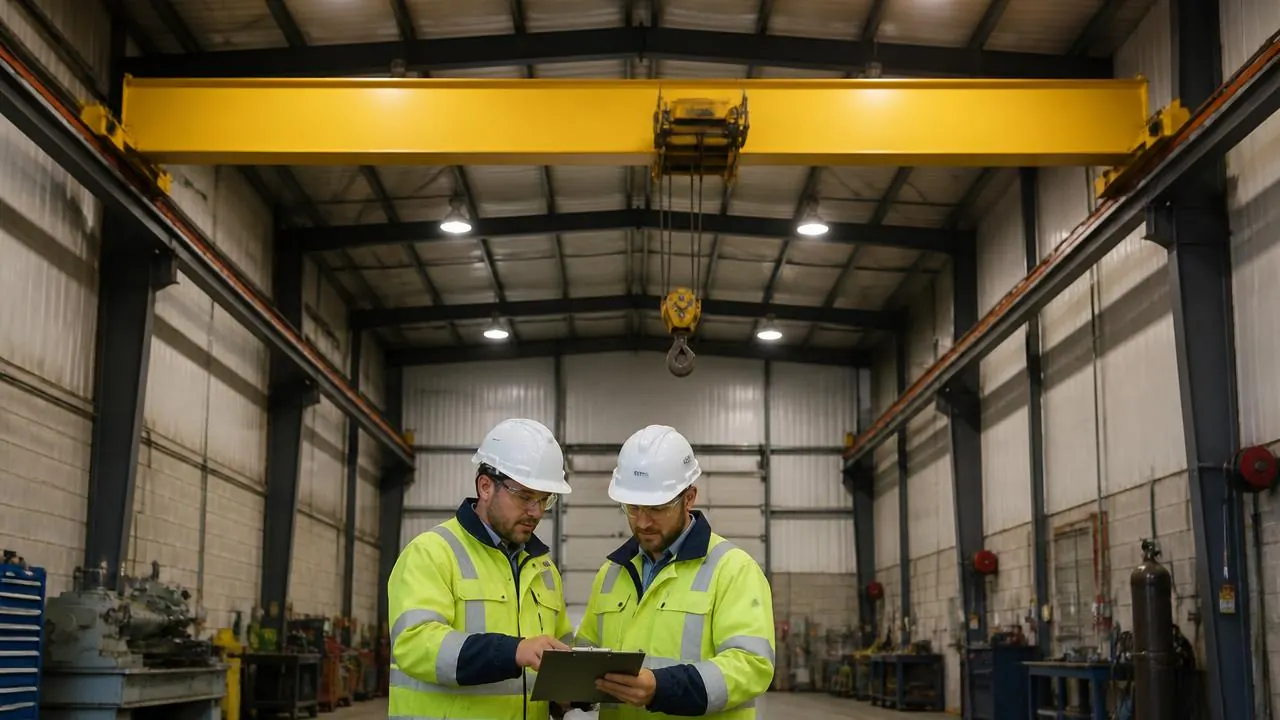
Most industrial facilities already have a crane service provider. Inspections happen, repairs get done, someone answers the phone at 2 a.m. when a hoist stops.
So the question is not usually "do we have someone maintaining our cranes?"
The better question is: do we have a maintenance strategy, or simply a service contract?
They are not the same thing, and the difference shows up in your downtime numbers, your capital surprises and your audit findings.
A crane service provider executes the work
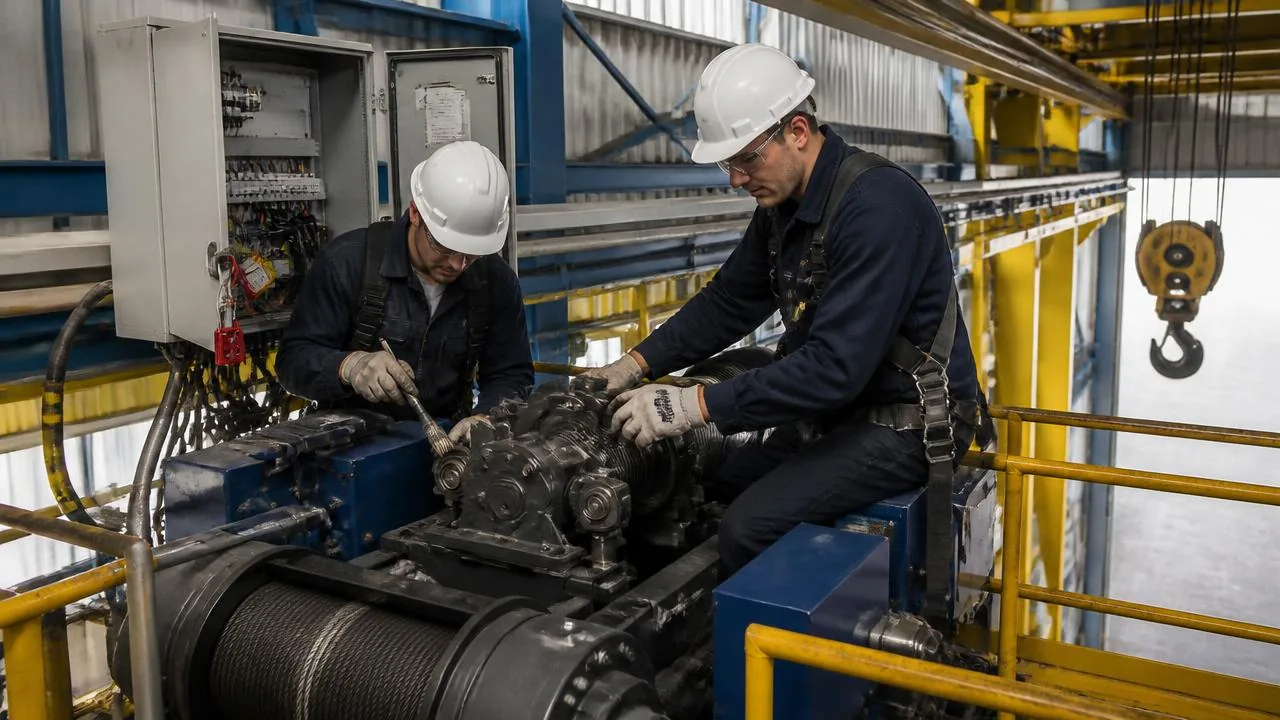
A good service contractor is essential. Typical service-provider scope includes:
- periodic and annual inspections
- preventive maintenance visits
- emergency call-out and response
- repairs and component replacement
- parts supply
- skilled labour and rigging
- troubleshooting on controls, drives and mechanical faults
None of that is optional, and none of it is a criticism. Someone has to put hands on the equipment, and specialized crane contractors do that work better than most in-house teams can.
But a service contract answers one question: who performs the work.
A crane maintenance program defines the strategy
An owner-level overhead crane maintenance program answers a different question: what work should be performed, why, when, and how you will know if it is working. A complete program defines:
- an asset register covering every crane, hoist, monorail and below-the-hook device
- crane criticality — which assets stop production if they stop
- actual duty versus nameplate duty (CMAA class as operated, not as sold)
- inspection requirements and who is qualified to perform them
- preventive-maintenance frequencies by asset, duty and environment
- deficiency classifications — safety-critical, operational, monitor
- repair prioritization and closure timelines
- documentation and records-retention requirements
- recurring-defect tracking across assets and cycles
- reliability metrics (availability, mean time between failures, repeat-fault rate)
- critical spare parts and obsolescence exposure
- multi-year capital forecasting
- repair / modernize / replace decision thresholds
- vendor performance expectations and how they are measured
The comparison, plainly
SERVICE CONTRACT — who performs the work? Scope of labour, response times, hourly rates, parts markup, inspection headcount.
MAINTENANCE PROGRAM — what work should be performed, why, when, and how is performance measured? Criticality, intervals, defect handling, records, spares, budget and accountability.
One is a supply agreement. The other is an owner-side management system. Most facilities have the first and assume it delivers the second.
Your service provider maintains the cranes. CAG helps make sure the maintenance program is working for the owner.
CAG does not need to replace the owner's crane service provider. The existing contractor can continue performing the inspections, maintenance and repairs. CAG provides the independent owner-side framework used to manage the program and evaluate its effectiveness.
That distinction matters commercially. Nobody has to be fired, no relationship has to be disrupted, and no re-tender is required to fix a weak program. In most cases the incumbent contractor performs better once the owner defines the expectation clearly.
Signs you may have a service contract but not a maintenance program
- every crane receives essentially the same service frequency, regardless of duty or criticality
- inspection deficiencies remain open for months with no closure date
- repeat failures are treated as separate events rather than tracked as a pattern
- nobody at the site can name the five most critical cranes
- there is no defined critical-spares strategy for long-lead components
- service reports are filed but never analyzed or trended
- maintenance spending is reactive and spikes without explanation
- repair-versus-replace decisions only happen after a failure
- there is no multi-year capital forecast for the hoisting fleet
- supplier performance is discussed but never measured
If four or more of those are true, the gap is strategy, not effort.
Where the money actually leaks
Weak programs rarely fail loudly. They leak:
- Uniform intervals. A Class D process crane and a Class B maintenance jib on the same annual schedule means one is over-served and the other is under-inspected.
- Untracked repeats. The same brake adjusted four times in a year is not four repairs — it is one unresolved root cause with a fifth invoice coming.
- Reactive spares. A hoist gearbox on a 14-week lead time becomes a 14-week outage when nobody flagged it as critical. See our hoist spare-parts strategy.
- No capital signal. Without condition-based forecasting, crane CapEx only enters the budget after the failure that forced it.
Standards context
CSA B167 in Canada and ASME B30 in the United States both place the maintenance and inspection obligation on the owner, not the contractor. Delegating execution is normal and expected. Delegating the program itself — letting the vendor define scope, frequency and adequacy — is where owners get exposed during an audit or after an incident. Note that the legally applicable edition of CSA B167 varies by province, industry and site requirements; confirm which edition applies at your site before rewriting anything.
How to close the gap in 90 days
- Build or verify the asset register — every hoisting asset, with duty, age, location and criticality.
- Re-calibrate intervals against actual duty and environment, not a flat annual default.
- Define deficiency classes and closure timelines, and start reporting open items by age.
- Pull the last 24 months of service reports and trend the repeats.
- Identify long-lead critical spares and decide what to hold.
- Publish the program document and give it to your contractor as the standard they execute against.
Review your crane maintenance program
CAG is independent — we do not sell cranes, parts, inspections or repair labour. That is what lets us tell you honestly whether the program is working, and where your existing service contract is doing more or less than it should.
Keep the companies that execute the work. Add an independent perspective when the decision carries significant technical, operational or financial consequences.
Start with a preventive maintenance program review, or bring us in for an independent second opinion on the program you already have. Related work: crane asset management, inspection program design, service-contract and vendor program review, and repair or replace assessments.
*By Bryan Whitty — Founder & Principal Consultant, Crane Advisory Group. 15+ years of overhead crane industry experience.*
FAQ
Frequently asked questions
- What is the difference between a crane service contract and a crane maintenance program?
- A service contract is a supply agreement that defines who performs inspections, preventive maintenance and repairs, at what rates and response times. A maintenance program is the owner-side strategy that defines what should be maintained, how often, how deficiencies are classified and closed, what spares are held, and how reliability and vendor performance are measured.
- Do I need to replace my crane service provider to build a maintenance program?
- No. The existing contractor can continue performing the inspections, maintenance and repairs. An owner-side maintenance program simply defines the standard they execute against and gives the owner a way to measure whether it is working.
- Who is legally responsible for overhead crane maintenance?
- The owner or employer. CSA B167 in Canada and ASME B30 in the United States place the inspection and maintenance obligation on the owner. Execution can be delegated to a contractor; accountability for the program cannot.
- How often should overhead cranes be maintained?
- Frequency should be set by duty class, environment and criticality rather than a flat annual default. A high-duty process crane in a hot or dusty environment needs materially more frequent attention than a low-duty maintenance jib in a clean bay.
- What does a crane maintenance program document contain?
- An asset register with criticality ranking, inspection and PM frequencies by asset, deficiency classification and closure workflow, documentation and retention requirements, critical spare-parts strategy, reliability metrics, a multi-year capital forecast, and defined vendor performance expectations.
Related services
How CAG helps on this
Related industries
Industry pages worth reading next
More field notes
14 min · Maintenance
Motors, Gearboxes and Gearing: The Obsolete Parts That Keep Cranes Down for Weeks
9 min · Maintenance
Who Should Define Your Overhead Crane Maintenance Scope — the Owner or the Service Contractor?
10 min · Service Contracts
Before You Renew Your Crane Service Contract: 10 Questions Owners Should Ask