Why You Need an Overhead Crane Maintenance Program — And Why to Hire CAG to Build It
Reactive maintenance is the most expensive way to run an overhead crane. Here's what a written, risk-based maintenance program actually does, and why an independent consultant is the right person to write it.
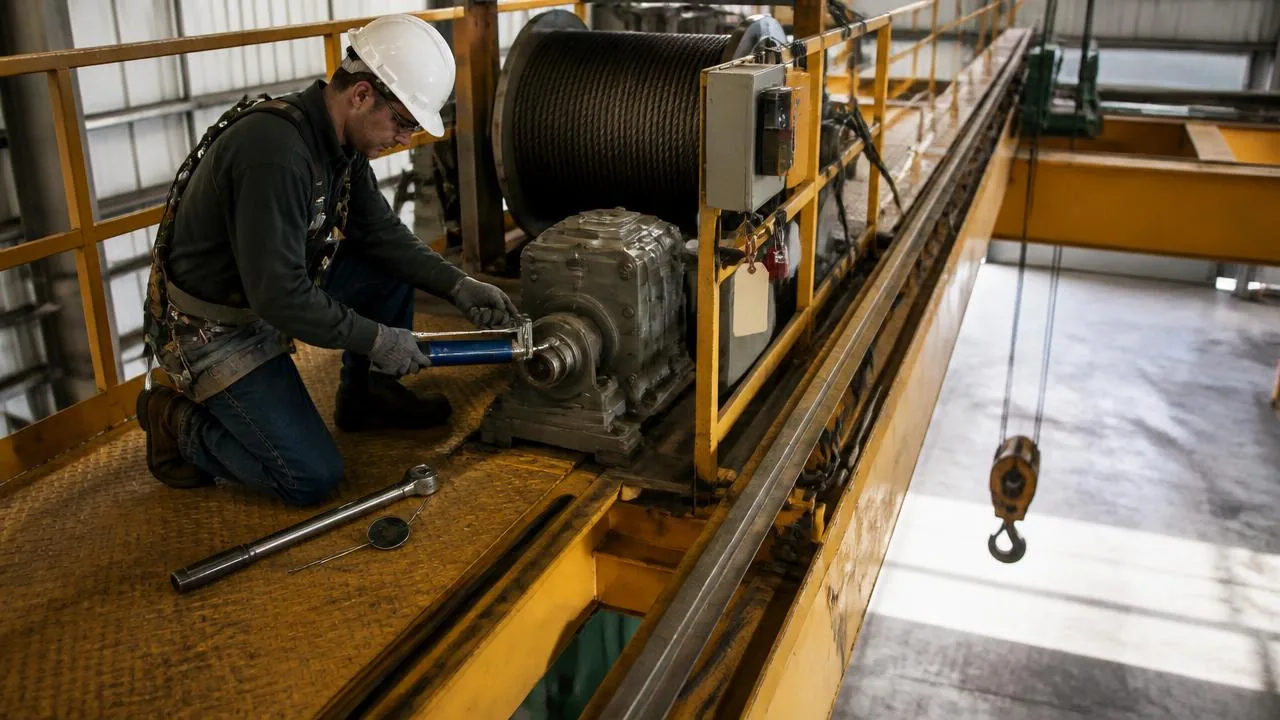
Most overhead crane owners we meet run on a fix-it-when-it-breaks model. The crane works, production is busy, and the maintenance team is already stretched. Then a hoist fails, a runway beam cracks, or a regulator asks for the written program — and the true cost of reactive maintenance shows up all at once.
A formal maintenance program is not a binder that sits on a shelf. It is the operating system that keeps your material handling equipment safe, compliant, and predictable across its entire life. This post explains what it actually is, why it matters, and why Crane Advisory Group is the right partner to build it.
What a maintenance program actually covers
A good overhead crane maintenance program answers five questions before the phone call at 2 a.m.:
- What gets inspected? Every crane, hoist, trolley, runway, control system, and safety device — by name, location, and criticality.
- How often? Intervals tied to CMAA service class, CSA B167 / ASME B30 requirements, environment, and operating history — not a calendar guess.
- By whom? Named roles with defined qualifications, training, and authorization.
- To what standard? Pass/fail criteria, defect categories, and acceptance limits that remove subjectivity.
- What happens next? Defect closure loop, spare-parts strategy, and escalation path for safety-critical findings.
Without those five elements, you do not have a program. You have a collection of work orders.
Why reactive maintenance always costs more
The average owner spends 30–50 percent more over the life of a crane when maintenance is event-driven. Three reasons:
- Emergency repairs carry premium labor, expedited freight, and production downtime. A scheduled hoist repair during a planned outage costs a fraction of the same repair during production.
- Small defects become major failures. A worn wheel that is not replaced on schedule loads the bridge structure differently. Six months later you are discussing beam repair or replacement.
- Regulatory and insurance exposure. CSA B167 and ASME B30 both require documented, periodic inspection and maintenance. After an incident, the first document requested is the written program. If it is missing or weak, liability follows.
The hidden value of a vendor-neutral program
Most crane service companies will happily "write you a program." What they usually deliver is a sales brochure for their own inspection and parts business. The incentives are misaligned: the more deficiencies they find, the more work they sell.
Crane Advisory Group does not sell cranes, parts, inspections, or repair labor. We sell the recommendation. That means:
- Intervals are set by risk and duty, not by how many service visits we can schedule.
- Inspection scope is defined by the standard and your equipment, not by what is easy to bill.
- Defects are triaged honestly — some can wait, some cannot, and the reasoning is documented.
- Your internal team or existing service provider can execute. You keep control of the work.
What CAG delivers
When we build a maintenance program for a client, the deliverable typically includes:
- A written program document aligned to CSA B167 or ASME B30, referencing the current edition.
- Equipment register with criticality ranking and interval assignment.
- Inspection templates for frequent, periodic, and annual scopes — see our Overhead Crane Inspection Guide for the framework.
- Defect classification and closure workflow.
- Spare-parts and obsolescence review.
- Training outline for operators, inspectors, and maintenance staff.
- Implementation roadmap with quick wins and high-risk gaps.
We also run independent audits of existing programs — often the most valuable engagement — because we can tell you what is actually missing without needing to sell you the fix. That work splits cleanly into two engagements: inspection program consulting for the inspection side, and service program consulting for the vendor contract that executes on the findings.
When to call us
The right time is before the next failure, audit, or insurance renewal. The most common triggers are:
- A new crane is being commissioned and you want the program in place from day one.
- An insurer or regulator has asked for documentation.
- You are consolidating multiple sites and need one consistent standard.
- Your current service provider wrote the program, and you want an independent review.
- You have repeat failures on the same asset class and suspect the program is the problem.
The bottom line
An overhead crane maintenance program is not overhead. It is the single highest-leverage control you have over safety, uptime, and life-cycle cost. And because the person who writes the program should not be the person who profits from the work, an independent consultant is the right choice.
If you want a program your team can actually execute — and that will stand up to an auditor — contact us or start with our preventive maintenance program service.
FAQ
Frequently asked questions
- What does a crane maintenance program include?
- An accurate crane register with duty classification, defined inspection and maintenance tasks with frequencies, assigned responsibility, deficiency tracking to closure, spare parts strategy and retained records.
- How is a maintenance program different from reactive repairs?
- Reactive repair responds after failure and downtime. A program schedules work against known wear rates, catches deficiencies at inspection and converts unplanned outages into planned ones.
- Who should build the program — the crane supplier or the owner?
- The owner owns the program. A supplier can perform the work, but frequencies, scope and record keeping should be defined independently so the program reflects the site's duty and risk, not a service contract's scope.
Related services
How CAG helps on this
overhead crane preventive maintenance program
Overhead Crane Maintenance, Inspection & Service Program Review
Read moreoverhead crane service program consultant
Overhead Crane Service Program Consultant
Read moreoverhead crane inspection program consultant
Overhead Crane Inspection Program Consultant
Read more
Related industries
Industry pages worth reading next
More field notes
14 min · Maintenance
Motors, Gearboxes and Gearing: The Obsolete Parts That Keep Cranes Down for Weeks
9 min · Maintenance
Who Should Define Your Overhead Crane Maintenance Scope — the Owner or the Service Contractor?
10 min · Service Contracts
Before You Renew Your Crane Service Contract: 10 Questions Owners Should Ask