Overhead Crane Operator Training in Canada
A course certificate documents training, but competency requires practical ability, equipment-specific knowledge and employer authorization. How CSA B167, rigging knowledge and qualified operators support safer, more reliable crane operations.
Shareable, print-ready edition of this article for offline reading and toolbox or management review.

How Crane Advisory Group Helps
Reading the standard is the easy part. Applying it to your cranes is the job.
Crane Advisory Group is an independent overhead crane and material handling consultancy led by Bryan Whitty, Founder & Principal Consultant, with 15+ years in the crane industry. We don't sell cranes, parts or service contracts — so what you get back is a recommendation, not a quote.
Compliance Gap Review
Where your maintenance, inspection and records program actually sits against the CSA B167 edition your province names — documented in writing.
Specs, Bids & Quotes Reviewed
Duty class, options, scope and exclusions checked before you sign — so you buy the crane or contract you need, not the one that was easiest to quote.
Independent Second Opinion
Repair, replace or modernize — reviewed by someone with no equipment, parts or service contract riding on the answer.
- In the overhead crane industry
- 15+ yrsIn the overhead crane industry
- Equipment, parts or service margin
- 0%Equipment, parts or service margin
- Standards referenced: CSA B167 · CMAA · ASME B30
- 3Standards referenced: CSA B167 · CMAA · ASME B30
- Scope and fee agreed before work starts
- FixedScope and fee agreed before work starts
Free download: CSA B167 Overhead Crane Compliance Checklist
A 5-page, vendor-neutral self-audit covering jurisdiction and edition, crane register, maintenance program, inspections and records, structure, electrical, training, modifications and vendor oversight. Enter your work email and the PDF opens immediately.
No newsletter spam. Every engagement follows the same documented review process.
See how an engagement worksA different cost structure than asking your crane supplier. Our work is advisory-only and scoped and quoted before it starts. There is no equipment margin, parts markup or service agreement attached to the advice — and a scoped review is a small line item next to the capital purchase, modernization or multi-year contract it is reviewing.
Competency, Rigging and CSA B167 Requirements
Why a training card is only the beginning of a defensible crane-safety program.
An overhead crane can be properly inspected, mechanically sound and still be operated unsafely. The missing control is often not the crane — it is the knowledge and judgement of the people operating, rigging, signalling and supervising the lift.
For industrial owners, the objective is not simply to send workers to a course. It is to establish and document that each operator is competent for the equipment, loads, controls and hazards they will actually encounter.
What Are the Overhead Crane Training Requirements in Canada?
Canada does not have one universal federal licence covering every overhead bridge crane operator in every workplace. Requirements come from the occupational health and safety legislation that applies to the jurisdiction, together with manufacturer instructions, workplace procedures, contractual requirements and applicable standards.
The terminology varies. A jurisdiction may require an operator, rigger or signaller to be competent, qualified, trained or authorized. The underlying expectation is similar: the worker must possess the knowledge, training and practical ability needed to perform the assigned work safely.
Alberta provides a clear example. Its Occupational Health and Safety Code, Part 6 requires a lifting device to be operated only by a competent worker authorized by the employer. An operator may also be required to demonstrate competence in operating the equipment and knowledge of load charts and the applicable code of signals. Before operating a particular lifting device, the operator must be familiar with recent logbook entries.
British Columbia similarly requires crane and hoist equipment to be operated by a qualified person who understands the work, hazards and controls and has been instructed in the specific equipment being used.
The practical conclusion is important: a generic wallet card does not remove the employer's responsibility to verify site- and equipment-specific competency.
Where CSA B167 Fits
CSA B167:26 is the current edition of the Canadian standard covering overhead cranes, gantry cranes, monorails, hoists and jib cranes. CSA Group describes the standard as establishing minimum requirements for design, inspection, testing, maintenance — including modifications and upgrades — and safe operation.
CSA B167 is an important benchmark, but it must be applied correctly. A CSA standard does not automatically replace provincial or federal law. Each organization must determine which edition is incorporated by regulation, required by contract or adopted within its crane-management program. Our CSA B167 hub and CSA B167 compliance advisory cover that determination in more detail.
The scope of CSA B167 also makes an important distinction. Below-the-hook lifting devices, slings and rigging hardware are generally outside the equipment scope of the standard, except where they relate to operator training.
In practical terms, overhead crane operator training should include rigging awareness. However, operator training should not be treated as a substitute for complete rigger qualification when workers perform complex or specialized rigging.
What Should a Qualified Overhead Crane Operator Understand?
A defensible qualification program combines theory, hands-on instruction, practical evaluation and documented employer authorization.
At minimum, an operator should demonstrate competency in the following areas.
Crane-Specific Knowledge
The operator should understand the crane's rated capacity, controls, operating modes, travel limits, emergency-stop functions, warning devices and special attachments.
Pre-Use Inspection
The operator should know how to identify obvious defects, check controls and safety devices, review the operating area and report conditions that could affect safe use.
Load Control
Operators should demonstrate smooth starts and stops, minimize load swing, avoid side pulling and shock loading, and maintain control during bridge, trolley and hoist movement.
Lift Planning
Before lifting, the team should confirm the load weight, crane capacity, path of travel, landing area, clearances, pedestrian exposure and communication method.
Signals and Communication
The operator should follow the designated signaller, understand the required hand signals and obey a stop signal regardless of who gives it.
Limits of Authority
A qualified operator understands when a lift falls outside their training, the crane's normal service, the available information or approved site procedures. At that point, the correct action is to stop and obtain direction.
Why Rigging Knowledge Is Inseparable from Crane Operation
The crane may have enough capacity, yet the lift can still fail below the hook.
Operators do not need to become advanced rigging engineers, but they must understand enough to recognize an unsafe connection, overloaded sling arrangement or unstable load before it leaves the floor.
Load Weight and Centre of Gravity
The operator and rigger need reliable load information. They must also understand how an off-centre connection can cause a load to tilt, rotate or shift.
Working Load Limit
Sling and hardware capacity must be suitable for the load, hitch and operating environment — not merely based on the number printed on one component.
Sling Angle
As the sling angle becomes smaller, sling tension increases and available lifting capacity decreases. Manufacturer capacity information must be used when selecting and arranging slings.
Hitch Selection
Vertical, choker, basket and bridle hitches behave differently. They are not interchangeable for every load or lifting condition.
Condition and Identification
Slings, shackles, hooks and lifting attachments require legible identification and pre-use inspection. Damaged, unidentified or questionable equipment must be removed from service in accordance with the applicable requirements and company procedures.
Load Path and Control
Taglines, exclusion zones, pinch-point awareness and clear signalling help keep workers separated from suspended and moving loads.
The Operational Advantages of Qualified Crane Operators
Effective training is often treated only as a safety expense. In a well-managed crane program, it is also an operating-performance control.
Qualified operators can provide meaningful advantages across the crane's lifecycle.
Fewer Incidents and Near Misses
Trained operators are more likely to identify unstable rigging, obstructed travel paths, personnel exposure and abnormal crane behaviour before movement begins.
Less Equipment and Product Damage
Smooth operation reduces load swing, collisions, shock loading and unnecessary stress on brakes, couplings, wire rope, end trucks and supporting structures.
More Predictable Productivity
Competent teams plan the lift, select suitable equipment and communicate consistently. Safe lifting becomes more predictable, with fewer delays caused by confusion or improvised decisions.
Earlier Defect Reporting
Operators who understand their equipment are better positioned to identify unusual sounds, brake-performance changes, control problems, damaged hooks or wire-rope conditions before they become larger failures.
Better Maintenance Information
Clear operator observations and logbook entries help maintenance teams distinguish equipment defects from application or operating problems.
Stronger Due Diligence
Documented training, practical evaluations, authorizations and reassessment actions provide evidence that foreseeable lifting hazards were actively managed.
What Should a Defensible Training and Qualification Program Include?
1. Requirement Mapping
Identify the applicable occupational health and safety legislation, corporate requirements, adopted CSA B167 edition, manufacturer instructions and site-specific lifting procedures.
2. Role Definition
Clearly separate the responsibilities of the operator, rigger, signaller, supervisor, lift planner and maintenance personnel.
3. Relevant Theory
Cover crane capacity, operating hazards, signals, inspections, controls, abnormal conditions and the rigging knowledge required for the worker's assigned role.
4. Hands-On Instruction
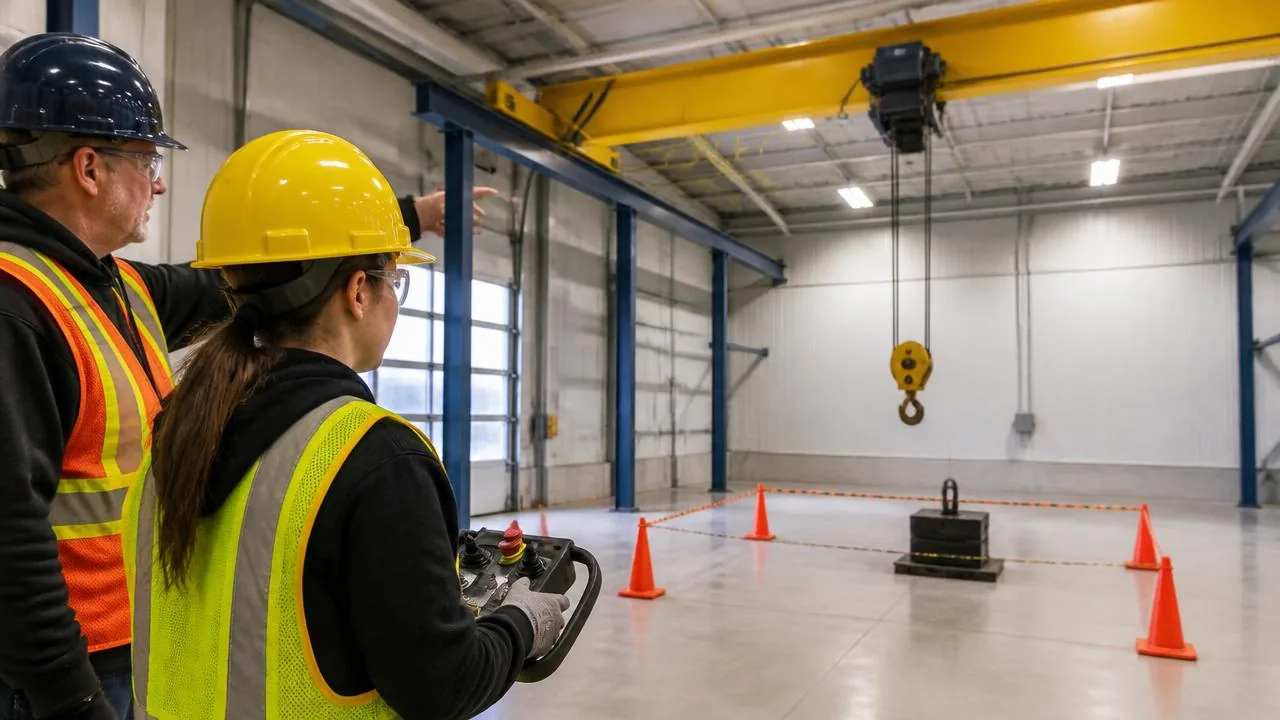
Train workers on the crane types and control systems they will actually use, including pendant, radio or cab controls where applicable.
5. Practical Evaluation
Require each worker to demonstrate inspection, setup, communication, load control, safe travel and landing. A written quiz alone does not demonstrate practical competency.
6. Employer Authorization
Identify which cranes and tasks the worker is authorized to perform, including any restrictions or supervision requirements.
7. Documentation
Retain the course content, instructor qualifications, theory results, practical evaluation, equipment covered, authorization and reassessment history.
8. Re-Evaluation Triggers
Reassess competency following an incident or near miss, observed unsafe operation, introduction of a new crane or control type, process changes, prolonged absence or an identified knowledge gap. There is no single universal refresher interval — refresher and re-evaluation requirements depend on applicable legislation, company policy, equipment, workplace changes and observed performance.
Training Records Are Part of the Safety System
Training documentation should show more than a course date.
A defensible record connects the worker to the equipment, practical evaluation, employer authorization and any restrictions. That distinction can become important during an audit or incident investigation.
In one WorkSafeBC fatal-incident investigation, inadequate and undocumented crane and rigging training was identified among the contributing factors.
A strong training record should answer a straightforward question: could the employer demonstrate, before the lift occurred, why it considered this worker competent for this crane and this work?
Questions Owners and Maintenance Leaders Should Ask
Independent Guidance for a Stronger Crane-Safety Program
Crane Advisory Group provides independent, manufacturer-neutral guidance to help industrial owners evaluate the structure of their overhead-crane programs.
We can review operator qualification records, rigging responsibilities, training-provider requirements, site procedures and the connection between safe operation, inspection, maintenance and asset management. See our crane safety and compliance review for how that work is structured.
The objective is not to create more paperwork. It is to make sure the training system reflects the cranes, loads and risks that exist in the facility — and that management can make informed decisions before a gap becomes an incident.
Official References
- CSA Group — CSA B167:26
- Alberta OHS Code, Part 6 — Cranes, Hoists and Lifting Devices
- Alberta OHS Code, Part 21 — Rigging
- Canadian Centre for Occupational Health and Safety — Overhead Crane Operation
- Canadian Centre for Occupational Health and Safety — Rigging or Sling Hitches
- WorkSafeBC — Occupational Health and Safety Regulation, Part 15: Rigging
- WorkSafeBC — Incident Investigation Summary
FAQ
Frequently asked questions
- Is there a national overhead crane operator licence in Canada?
- No. There is no single universal federal licence covering every overhead bridge crane operator in every workplace. Requirements come from the occupational health and safety legislation of the applicable jurisdiction, together with manufacturer instructions, workplace procedures, contractual requirements and applicable standards.
- Does a training card make an operator competent?
- A course certificate documents that training was delivered. Competency is demonstrated through knowledge, practical ability, familiarity with the specific equipment and controls being used, and employer authorization for the cranes and tasks assigned.
- Does CSA B167 cover rigging and below-the-hook devices?
- Below-the-hook lifting devices, slings and rigging hardware are generally outside the equipment scope of CSA B167, except where they relate to operator training. Operator training should include rigging awareness, but it is not a substitute for full rigger qualification where workers perform complex or specialized rigging.
- How often should crane operator competency be re-evaluated?
- There is no single universal interval. Refresher and re-evaluation requirements depend on applicable legislation, company policy, the equipment in use, workplace changes and observed performance. Common triggers include an incident or near miss, observed unsafe operation, a new crane or control type, process changes, prolonged absence or an identified knowledge gap.
Related services
How CAG helps on this
Related industries
Industry pages worth reading next
More field notes
7 min · Training
Overhead Crane Operator Training: The Theoretical and Practical Sides Both Matter
10 min · Overhead Crane
RFID Access Cards for Overhead Cranes: Qualified Operators Only, Full Accountability
6 min · CSA B167
CSA B167:26 Is Current — But Which Edition Actually Applies at Your Canadian Site?