Vacuum Lifters vs. Magnet Lifters: Choosing the Right Below-the-Hook Attachment for Your Overhead Crane
Compare vacuum lifters and magnetic lifters for overhead cranes. Learn how each works, where each excels, key industries, safety considerations, and how to specify the right below-the-hook attachment.
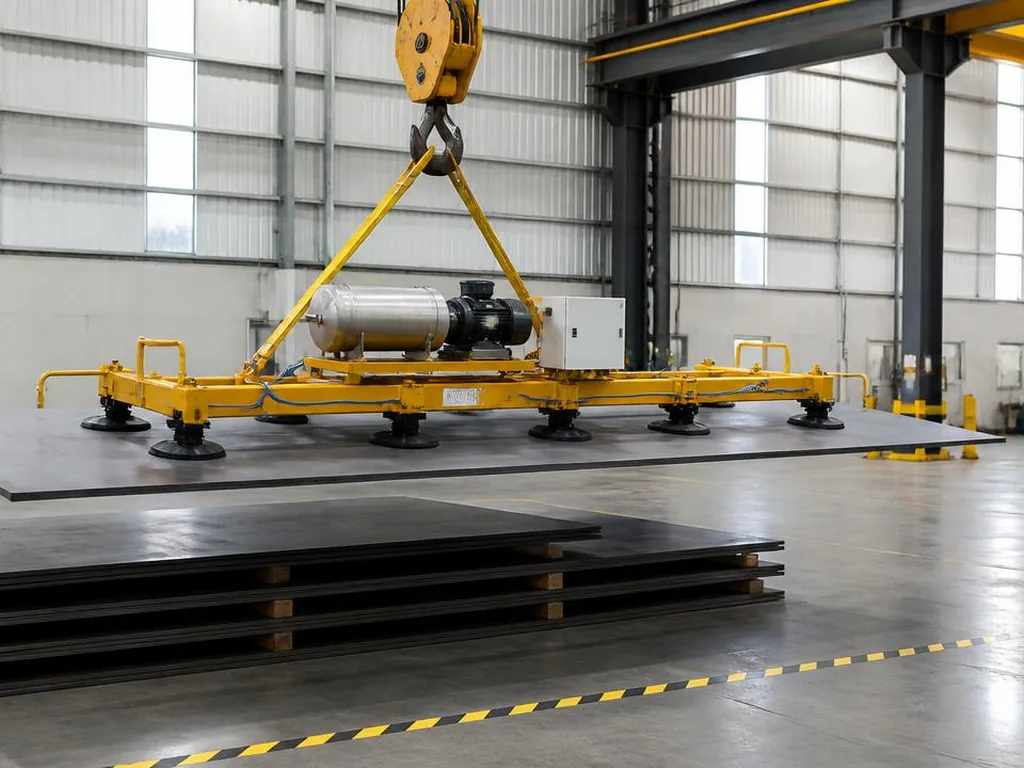
When an overhead crane needs to move plate, sheet, coil, or finished goods, the hook alone is rarely enough. The right below-the-hook attachment turns a general-purpose crane into a purpose-built material handler. Two of the most common choices are vacuum lifters and magnet lifters. Both grip the load from above, but they work on completely different principles and suit very different applications.
This guide explains how each technology works, where each one excels, and how to decide which is right for your operation. If you are also comparing other attachment types, see our overview of below-the-hook lifting attachments.
What is a vacuum lifter?
A vacuum lifter uses suction cups, a vacuum pump or venturi generator, and a sealed reservoir to grip a load. When the cups contact a flat, non-porous surface, air is evacuated, creating a pressure differential that holds the load. Release is controlled — either by venting the vacuum or, on more sophisticated units, by gradually restoring pressure so the load settles rather than drops.
Vacuum lifters are typically suspended from a crane hook or a dedicated hoist beam. They can be configured with a single large pad for sheet goods, multiple pads in a frame for larger plates, or specialized arrays for curved surfaces such as pipes, barrels, or glass.
Key characteristics:
- Grip force comes from atmospheric pressure, not friction or magnetism.
- Works on any smooth, non-porous surface — steel, aluminum, glass, polished stone, plastic, coated sheet, even some composites.
- Does not mark or magnetize the load, which matters for painted, coated, or electronics-sensitive products.
- Requires a reasonably flat sealing surface; deep rust, heavy mill scale, or significant warping can break the seal.
- Holds only while vacuum is maintained; loss of power or pump failure must be addressed with redundant vacuum reservoirs, alarms, and mechanical safety latches.
What is a magnet lifter?
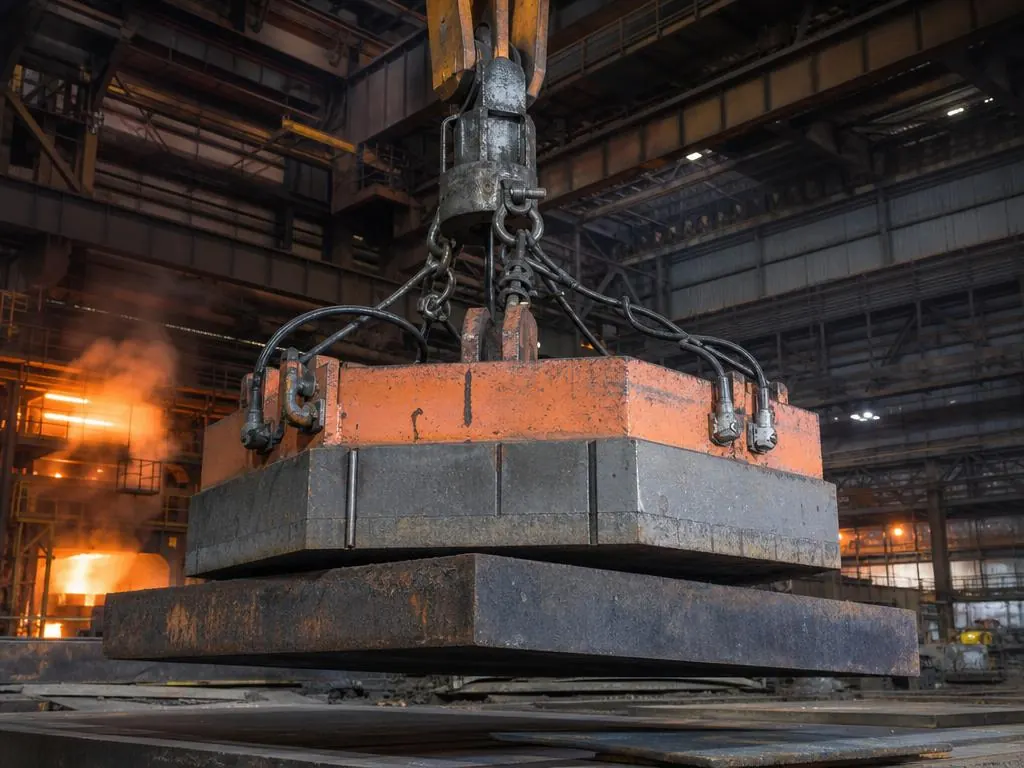
A magnet lifter uses magnetic force to grip ferromagnetic materials — primarily steel and iron. There are two main types:
- Permanent magnetic lifters use a mechanical lever to rotate internal permanent magnets, aligning or misaligning their fields to engage or release the load. They require no external power to hold.
- Electromagnetic lifters use a DC coil to generate a magnetic field. They can be switched on and off electrically and are common in high-duty steel handling.
- Electro-permanent magnetic lifters combine both ideas: permanent magnets provide the holding force, while a short electrical pulse switches the field on or off. They hold without continuous power but need a brief energization cycle to release.
Key characteristics:
- Grip force comes from magnetic flux through the load material.
- Only works on ferromagnetic materials — carbon steel, some stainless steels, cast iron. Aluminum, copper, non-ferrous metals, wood, glass, and composites are not liftable.
- Can handle rougher, hotter, and more uneven surfaces than vacuum lifters, depending on magnet design.
- May leave residual magnetism in the load, which can be a problem for downstream welding, machining, or electronics assembly.
- Permanent magnets do not need power to hold, but electromagnets require a reliable power supply and battery backup or mechanical safety systems in case of power loss.
Vacuum lifters vs. magnet lifters: side-by-side comparison
| Factor | Vacuum Lifter | Magnet Lifter |
|---|---|---|
| Lifting principle | Atmospheric pressure differential | Magnetic flux |
| Material compatibility | Smooth, non-porous materials; ferrous and non-ferrous | Ferromagnetic materials only |
| Surface condition | Needs a reasonably flat, clean seal | Tolerates rougher, scaled, or uneven surfaces |
| Load finish sensitivity | Non-marring; ideal for painted, coated, or polished surfaces | Can leave marks or residual magnetism |
| Power requirement | Pump or venturi needs continuous or frequent power | Permanent magnets need none; electromagnets need continuous power |
| Temperature limits | Seals degrade at high temperatures; special pads available for warm loads | High-temperature magnets available for hot steel |
| Speed of cycle | Fast engage/release; excellent for repetitive sheet handling | Very fast; permanent magnets release by lever, electromagnets by switch |
| Safety redundancy | Vacuum reservoir, alarms, mechanical latches | Battery backup for electromagnets; mechanical safety shims for permanent magnets |
| Typical maintenance | Pad wear, filter cleaning, pump service | Pole shoe wear, electrical connections, demagnetization checks |
| Best for | Sheet metal, glass, stone, coated products, delicate finishes | Steel plate, slab, billet, coil, scrap, structural sections |
Industries that use vacuum lifters
Vacuum lifters are common wherever the load is flat, smooth, and easily damaged:
- Glass and fenestration: large sheets of architectural glass, insulated units, and mirrors.
- Stone and countertop fabrication: polished granite, quartz, marble, and engineered stone slabs.
- Sheet metal fabrication: laser-cut blanks, stainless steel panels, and pre-painted coil stock.
- Automotive and appliance manufacturing: body panels, doors, hoods, and appliance skins.
- Wood and panel products: MDF, particleboard, plywood, and finished furniture components.
- Logistics and warehousing: carton, drum, and bag handling with specialized vacuum attachments.
In these industries, the priority is usually surface protection and precise placement. A vacuum lifter lets one operator pick a sheet from a rack, rotate it, and place it on a cutting table or assembly fixture without clamps, slings, or fork damage.
Industries that use magnet lifters
Magnet lifters dominate where the material is steel, the environment is harsh, and cycle speed matters:
- Steel mills and service centers: hot-rolled and cold-rolled coils, plates, slabs, and billets.
- Foundries and forges: castings, forgings, and rough-machined steel parts.
- Scrap and recycling: steel scrap bundles, plate offcuts, and demolition steel.
- Shipbuilding and heavy fabrication: thick plate, structural sections, and sub-assemblies.
- Rail and infrastructure: rail sections, steel beams, and large fabrications.
- Automotive stamping plants: steel blanks and stamped parts in high-volume press lines.
In steel-heavy industries, magnet lifters are often integrated into automated crane systems that move coils from storage to slitting, cut-to-length, or shipping lines with minimal human intervention.
Safety and compliance considerations
Both technologies must be selected, installed, and maintained under the crane's overall inspection and maintenance program. In Canada, CSA B167 and CSA Z150 address crane and hoist inspection; in the United States, ASME B30.20 covers below-the-hook lifting devices. Key points:
- Rated capacity: the lifter must be rated for the load at the actual orientation and center of gravity. A magnet rated for flat plate may not hold the same weight on round bar or thin sheet.
- Safety factor: most standards require a minimum safety factor on the lifting device, but the effective safety also depends on the condition of the sealing surface or the magnetic circuit.
- Proof testing and certification: new and repaired lifters should be proof-load tested and certified before service.
- Operator training: operators must understand engagement indicators, alarm signals, and emergency release procedures.
- Documentation: keep load-test certificates, maintenance records, and inspection checklists with the crane file.
How to choose: a practical checklist
Use this checklist when specifying a below-the-hook lifter for an overhead crane:
- What is the material? If it is not ferromagnetic, a magnet lifter is not an option.
- What is the surface condition? Rough, scaled, or porous surfaces favor magnets; smooth, sealed surfaces favor vacuum.
- Is surface finish critical? Painted, coated, polished, or glass surfaces usually need vacuum.
- What is the temperature? Hot steel above roughly 200 °C can damage standard vacuum seals; high-temperature magnets are available.
- What is the cycle rate? High-speed automated lines may prefer electromagnets or fast-cycling vacuum systems.
- Is power reliability a concern? Permanent magnets and electro-permanent magnets hold without continuous power; vacuum pumps and electromagnets need power and backup strategies.
- What is the load geometry? Thin sheet may deflect under vacuum; round or irregular shapes may need custom magnet pole shoes or vacuum cup layouts.
- What standards apply? Confirm CSA B167, ASME B30.20, or CMAA requirements in your jurisdiction.
- Who will inspect and maintain it? Match the technology to your in-house capability and spare-parts strategy.
- What is the total cost of ownership? Include pads, pole shoes, pump service, power consumption, and downtime, not just the purchase price.
When to bring in an independent consultant
If your team is unsure whether a vacuum or magnet lifter fits a new process, or if vendors are quoting very different capacities for the same load, an independent review of the application can prevent an expensive mismatch. We help owners compare technologies, verify vendor calculations, and write clear technical specifications so the chosen lifter matches the duty, the load, and the crane.
The right lifter does more than move material — it protects product quality, reduces cycle time, and removes the temptation for operators to improvise rigging that was never designed for the load.
FAQ
Frequently asked questions
- Can a vacuum lifter handle rusty steel plate?
- Light surface rust is usually manageable with the right cup material and a higher-capacity safety margin. Heavy, flaky mill scale or deep pitting breaks the seal and reduces capacity. In those conditions a magnet lifter is often the better choice.
- Will a magnet lifter work on stainless steel?
- Only on magnetic grades of stainless steel, such as 400-series ferritic or martensitic grades. Common 300-series austenitic stainless steels are non-magnetic and cannot be lifted with standard magnets.
- What happens if power is lost while a vacuum lifter is holding a load?
- A properly designed vacuum system has a sealed reservoir that maintains vacuum for a defined hold time — often several minutes — plus an audible and visual alarm. Some systems also include mechanical safety latches. Operators must lower the load to a safe support before the reserve is exhausted.
- Are electro-permanent magnets safer than electromagnets?
- Electro-permanent magnets hold without continuous power, so a power outage does not immediately release the load. They still need a brief electrical pulse to release, and they require the same rated-capacity verification, inspection, and backup procedures as any lifting magnet.
- Can one overhead crane use both vacuum and magnet lifters?
- Yes, provided the crane capacity, hook height, and beam spacing suit each attachment. Many plants keep multiple below-the-hook devices and swap them for different jobs. Each attachment must be load-tested, tagged, and included in the crane's inspection records.
Related services
How CAG helps on this
Related industries
Industry pages worth reading next
More field notes
10 min · Overhead Crane
RFID Access Cards for Overhead Cranes: Qualified Operators Only, Full Accountability
8 min · Below-the-Hook
Below-the-Hook Lifting Attachments: Spreader Bars, Clamps, Vacuum Lifters and Magnets
9 min · Maintenance
Who Should Define Your Overhead Crane Maintenance Scope — the Owner or the Service Contractor?