Overhead Crane Modernization Project Timeline: From Planning to Final Inspection
A phase-by-phase overhead crane modernization timeline — planning, engineering, demolition, structural reinforcement, rail alignment, installation, commissioning and final inspection — with realistic durations.
How Crane Advisory Group Helps
Reading the standard is the easy part. Applying it to your cranes is the job.
Crane Advisory Group is an independent overhead crane and material handling consultancy led by Bryan Whitty, Founder & Principal Consultant, with 15+ years in the crane industry. We don't sell cranes, parts or service contracts — so what you get back is a recommendation, not a quote.
Compliance Gap Review
Where your maintenance, inspection and records program actually sits against the CSA B167 edition your province names — documented in writing.
Specs, Bids & Quotes Reviewed
Duty class, options, scope and exclusions checked before you sign — so you buy the crane or contract you need, not the one that was easiest to quote.
Independent Second Opinion
Repair, replace or modernize — reviewed by someone with no equipment, parts or service contract riding on the answer.
- In the overhead crane industry
- 15+ yrsIn the overhead crane industry
- Equipment, parts or service margin
- 0%Equipment, parts or service margin
- Standards referenced: CSA B167 · CMAA · ASME B30
- 3Standards referenced: CSA B167 · CMAA · ASME B30
- Scope and fee agreed before work starts
- FixedScope and fee agreed before work starts
Free download: CSA B167 Overhead Crane Compliance Checklist
A 5-page, vendor-neutral self-audit covering jurisdiction and edition, crane register, maintenance program, inspections and records, structure, electrical, training, modifications and vendor oversight. Enter your work email and the PDF opens immediately.
No newsletter spam. Every engagement follows the same documented review process.
See how an engagement worksA different cost structure than asking your crane supplier. Our work is advisory-only and scoped and quoted before it starts. There is no equipment margin, parts markup or service agreement attached to the advice — and a scoped review is a small line item next to the capital purchase, modernization or multi-year contract it is reviewing.
The question we get asked most often on an overhead crane modernization is not "what will it cost" — it is "how long will my bay be down". Owners can usually find capital. What they cannot find is an eight-week hole in a production schedule that nobody warned them about.
This is the timeline we build with clients: eight phases from first planning meeting to final inspection sign-off, with realistic durations, what has to be finished before the next phase can start, and where projects actually slip. If you have not yet scoped the structural side, read what the building has to do first alongside this.
A useful rule up front: on a typical single-crane modernization, roughly 70% of the calendar is planning, engineering and fabrication — and only 20–30% is site work. Owners who compress the front end pay for it during the outage.
Phase 1 — Planning and feasibility (4–8 weeks)
Nothing here happens on site, and everything downstream depends on it.
- Define the driver: capacity increase, duty class increase, obsolete controls, reliability, safety compliance, or a combination.
- Recover documentation — crane data plate, GA drawings, wheel loads, runway girder design, building structural and foundation drawings.
- Condition assessment of the existing crane, runway and structure.
- Baseline runway survey against CMAA 70/74 tolerances.
- Repair or replace assessment and an order-of-magnitude budget.
- Outage strategy: full shutdown, partial bay isolation, or work around production with a temporary lift plan.
Deliverable: a scope definition, a budget class estimate, and a decision on modernize vs. replace.
Where it slips: missing drawings. On plants over thirty years old, allow two to three extra weeks for field measurement and reverse engineering.
Phase 2 — Engineering and specification (6–12 weeks)
- Structural analysis of runway girders, brackets, columns, base plates and foundations against the new wheel loads and the new fatigue duty class.
- Define the remediation scope: cover plates and stiffeners, girder replacement, rail upgrade, pony columns, anchor and footing work.
- Write the crane technical specification — duty class, speeds, controls, options, spare parts, documentation and test requirements.
- Package the structural scope with clear interface responsibility between the crane vendor and the steel contractor.
- Tender, bid review and award.
Deliverable: stamped structural design, an issued-for-tender crane spec, and an awarded contract.
Where it slips: unclear interfaces. If the drawings do not say who supplies rail, clips, sole plates and anchor bolts, both bidders leave it out and you buy it twice.
Phase 3 — Fabrication and long-lead procurement (12–26 weeks)
This runs in parallel with outage planning, and it is usually the critical path.
- Crane structure fabrication, hoist and drive manufacture, panel build.
- Steel fabrication for girder reinforcement and pony columns.
- Rail, clips and sole plates — often a 10–16 week lead in itself.
- Approval drawing review and cycle time (build two review cycles into the schedule).
- Factory acceptance testing of drives and controls where specified.
Where it slips: approval drawings sitting on the owner's desk. Every week of review delay is a week added to the outage date.
Phase 4 — Outage mobilization and demolition (1–2 weeks on site)
The outage clock starts here.
- Isolation, lockout, permits, exclusion zones, floor protection and rigging studies.
- Mobilize mobile cranes, boom lifts and welding equipment.
- Remove the existing crane — hoist and trolley first, then bridge, then end trucks.
- Remove old rail, clips and any deteriorated sole plates and shims.
- Expose structural connections for inspection.
Where it slips: discovery. Once the rail comes off you can finally see the girder top flange and weld condition. Carry a contingency of 10–15% of the outage duration for what the demolition exposes.
Phase 5 — Structural reinforcement and concrete work (2–5 weeks on site)
- Girder reinforcement — cover plates, web stiffeners, or full girder replacement.
- Bracket and column strengthening; new pony columns where span reduction is the economical answer.
- Base plate, anchor bolt and footing work, including concrete cure time — allow 7 to 28 days depending on the mix and the load case; this is a hard constraint that no amount of schedule pressure removes.
- NDT of new and repaired welds, and coating repair.
Where it slips: concrete cure and weld inspection cannot be compressed. Sequence them so other work continues around them.
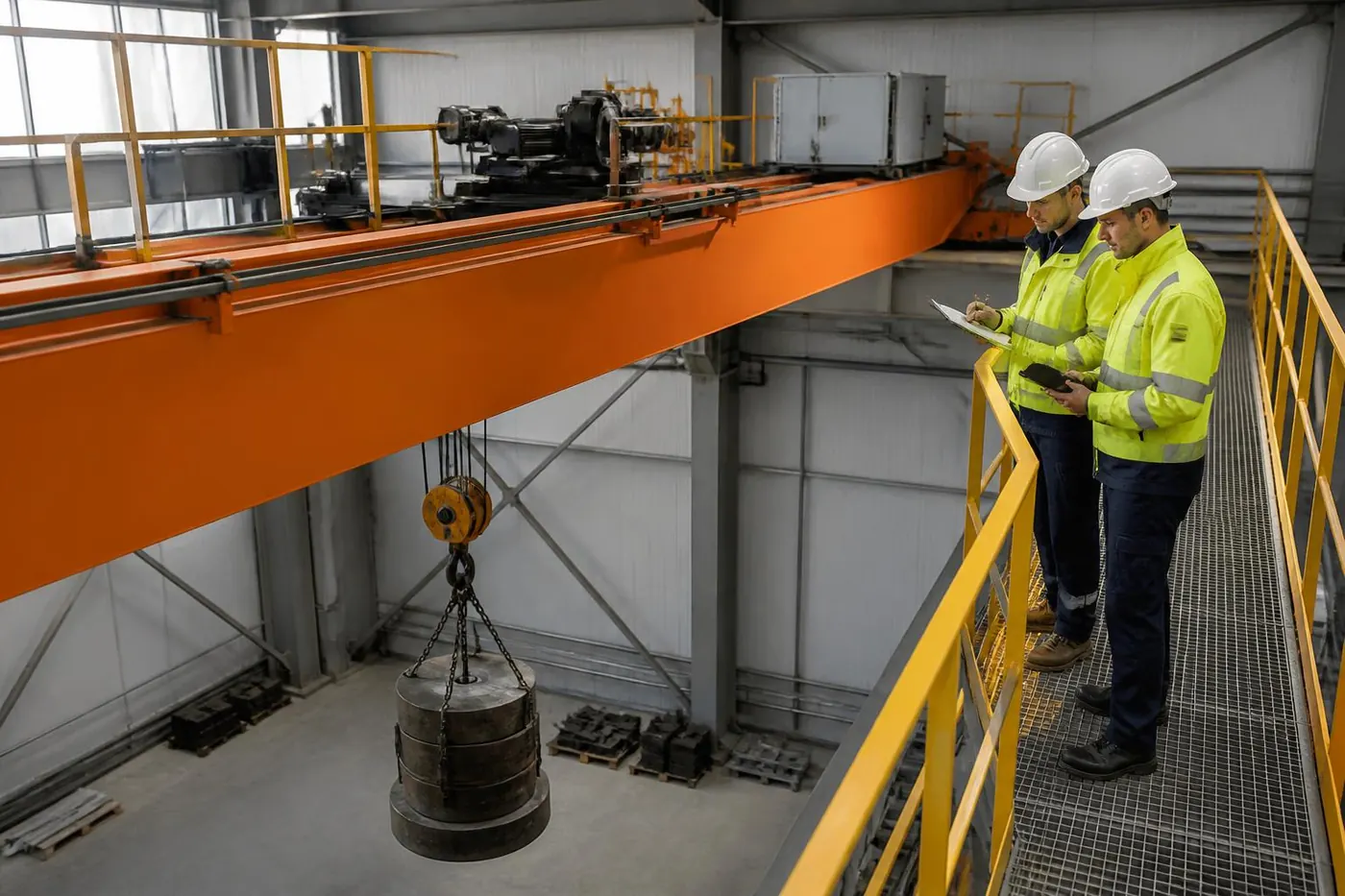
Phase 6 — Rail installation and runway alignment (1–2 weeks on site)
Do not treat this as a punch-list item. It governs the life of the new crane.
- Install sole plates, shims and rail; weld or bolt rail joints per specification.
- Align to CMAA 70/74 tolerances for span, straightness, elevation, cross-elevation and rail-to-rail level.
- Survey with a robotic total station or laser tracker, adjust, and re-survey.
- Issue a signed as-built alignment report before the crane goes up.
Where it slips: owners who let the crane be installed on an "we'll adjust it later" runway. Later never comes, wheel and rail wear starts on day one, and the OEM will point at the survey report when the warranty claim arrives.
Phase 7 — Installation and commissioning (1–3 weeks on site)
- Erect end trucks, bridge, trolley and hoist; install festoon or conductor bar, and the electrical supply.
- Mechanical checks — wheel contact, square and diagonal, bumper clearances, brake settings.
- Electrical checks — phasing, limit switches, overload protection, VFD parameter setting and speed verification.
- No-load functional testing of every motion and every limit.
- [Load testing](/blog/overhead-crane-load-testing-and-commissioning-requirements) — rated load, then proof load at 125% per ASME B30.2 / CSA B167 for new and altered cranes, with deflection measured against the design limit.
- Operator and maintenance training, and handover of the documentation package.
Where it slips: documentation. Withhold a meaningful portion of payment against the O&M manuals, as-builts, parts lists and test records or you will still be chasing them a year later.
Phase 8 — Final inspection and closeout (1–2 weeks)
- Independent third-party inspection against the specification and the applicable code.
- Punch list issued, worked and re-verified — with the owner, not the vendor, deciding what is closed.
- Final alignment and deflection records filed as the new baseline.
- Update the preventive maintenance program with the new equipment, new intervals and the new spare parts list.
- Warranty start date confirmed in writing, with the terms tied to the as-built survey.
Realistic overall duration
- Controls and hoist modernization, no structural work — 2–4 months to award, 3–4 months fabrication, 1–2 week site outage. Total 6–9 months.
- Capacity upgrade with girder and rail work — 3–5 months to award, 4–6 months fabrication, 4–8 week site outage. Total 9–14 months.
- Full crane replacement with structural reinforcement and new foundations — 4–6 months to award, 5–7 months fabrication, 6–12 week site outage. Total 12–18 months.
The site outage — the number the plant manager cares about — is a small fraction of the total. That is the argument for starting the engineering a year before the shutdown window, not three months before it.
The five things that actually cause overruns
- Starting procurement before the structural assessment. The crane arrives, the runway cannot take it, and the outage stretches while steel is designed on the fly.
- No baseline runway survey. Alignment problems surface at commissioning, when correction is at its most expensive.
- Unclear vendor interfaces. Rail, clips, anchors, power supply and the electrical tie-in are the classic gaps.
- Slow approval drawing turnaround on the owner's side.
- No contingency for demolition discovery. What is under the old rail is unknown until it is off.
Where CAG fits
We build and hold this schedule on the owner's side: scope definition, coordination of the structural engineer and surveyor, specification writing, bid review, interface management between crane vendor and steel contractor, witnessing the load test, and running the final inspection and punch list. We do not sell cranes or steel, so the schedule we defend is yours.
Planning a modernization outage? Talk to us before the enquiry goes out — see crane modernization consulting and owner's representative, or get in touch.
FAQ
Frequently asked questions
- How long does an overhead crane modernization take?
- A controls and hoist modernization typically runs 6 to 9 months end to end with a 1 to 2 week site outage. A capacity upgrade with girder and rail work runs 9 to 14 months with a 4 to 8 week outage. A full replacement with structural reinforcement and new foundations runs 12 to 18 months with a 6 to 12 week outage. Most of the calendar is planning, engineering and fabrication, not site work.
- How long will my crane bay be shut down during a modernization?
- The site outage is usually 1 to 12 weeks depending on scope: 1 to 2 weeks for demolition, 2 to 5 weeks for structural reinforcement and concrete cure, 1 to 2 weeks for rail installation and alignment, and 1 to 3 weeks for installation, load testing and commissioning. Carry 10 to 15% contingency for what demolition exposes.
- What are the phases of a crane modernization project?
- Planning and feasibility, engineering and specification, fabrication and long-lead procurement, outage mobilization and demolition, structural reinforcement and concrete work, rail installation and runway alignment, installation and commissioning, and final inspection and closeout.
- When should the runway survey be done in a modernization?
- Twice. A baseline survey during planning, before any design or procurement, so the structural scope is priced correctly — and a re-survey after rail installation and alignment, signed off before the new crane is erected. Installing on an out-of-tolerance runway causes immediate wheel and rail wear and typically voids warranty claims.
- Is a load test required after a crane modernization?
- Yes. ASME B30.2 and CSA B167 require a proof load test at 125% of rated capacity for new or altered cranes, including capacity upgrades and structural repairs. The test should be witnessed on the owner's behalf, with deflection measured against the design limit and the results filed as the new baseline.
- What causes crane modernization projects to run over schedule?
- The most common causes are procuring the crane before the structural assessment, skipping the baseline runway survey, unclear supply interfaces between crane vendor and steel contractor, slow owner-side approval drawing review, and no contingency for what demolition uncovers under the old rail.
Related services
How CAG helps on this
overhead crane modernization consultant
Overhead Crane Modernization Consultant
Read moreoverhead crane owner's representative
Owner's Representative — Overhead Crane Projects
Read moreoverhead crane bid review
Overhead Crane Bid Review
Read moreoverhead crane specification review
Overhead Crane Specification Review
Read moreoverhead crane capital planning consultant
Overhead Crane Capital Planning Consultant
Read more
Related industries
Industry pages worth reading next
More field notes
12 min · Overhead Crane
Overhead Crane Modernization: Capacity Upgrades, Structural Reinforcement and What the Building Has to Do First
10 min · Overhead Crane
Crane Runway Rail Alignment: The Hidden Cause of Wheel, Rail and Structural Wear
14 min · Maintenance
Motors, Gearboxes and Gearing: The Obsolete Parts That Keep Cranes Down for Weeks